TDS (Tax Deducted at Source)
A system of collecting income tax where the payer deducts tax at prescribed rates at the time of making specified payments.
Definition
Tax Deducted at Source (TDS) is a mechanism of indirect tax collection introduced by the Income Tax Department of India to collect tax at the very source of income. Under this system, the person or entity making a payment (known as the deductor) is required to deduct tax at prescribed rates before releasing the payment to the recipient (known as the deductee). The deducted amount is then deposited with the government on behalf of the payee, who can claim credit for the TDS against their total tax liability when filing their income tax return. TDS applies to a wide range of payments including salaries, interest, rent, professional fees, contractor payments, commission, and more.
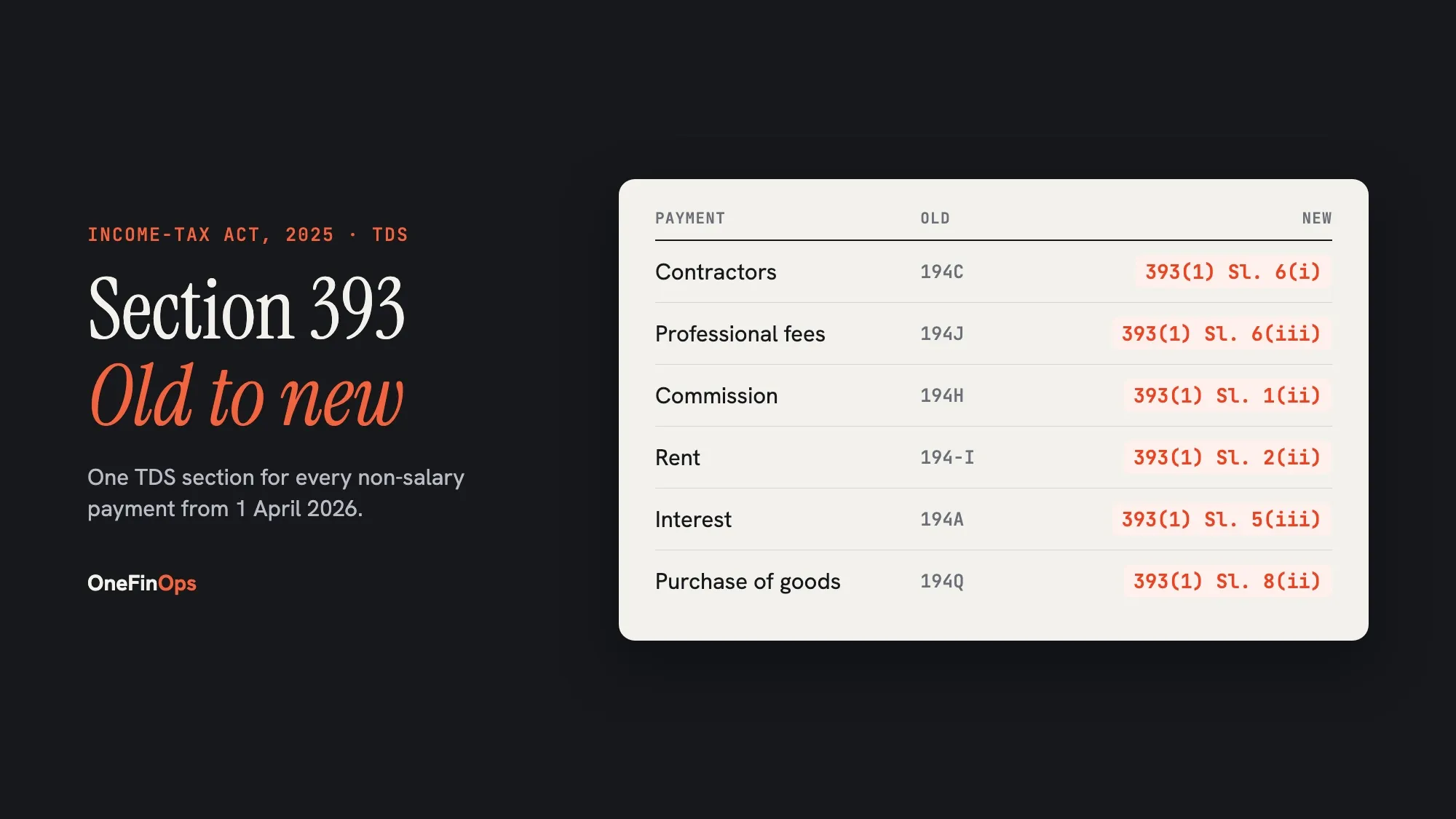
The TDS framework is governed by multiple sections of the Income Tax Act, 1961, with each section specifying the nature of payment, applicable rate, threshold limits, and compliance requirements. Key sections include 192 (salary), 194A (interest other than on securities), 194C (contractor payments), 194H (commission/brokerage), 194I (rent), 194J (professional/technical fees), and 195 (payments to non-residents). The deductor must obtain a TAN (Tax Deduction Account Number), deduct TDS at the correct rate, deposit it with the government by the 7th of the following month (or 30th April for March deductions), and file quarterly TDS returns disclosing all deductions made.
TDS is one of the most significant compliance obligations for Indian businesses, as it touches virtually every payment a company makes. Errors in TDS computation, late deposit, or incorrect filing of returns can result in disallowance of business expenditure under Section 40(a)(ia), interest at 1-1.5% per month on delayed deposits, and penalties for late filing of returns. Modern platforms like OneFinOps streamline the entire TDS lifecycle by automatically identifying applicable sections based on payment type and vendor category, computing deductions, generating challans, and preparing quarterly returns (Form 24Q, 26Q, 27Q), ensuring businesses stay compliant while minimizing manual effort.
Key Points
- TDS must be deposited with the government by the 7th of the month following deduction (30th April for deductions made in March), with interest of 1.5% per month for late deposits.
- Every deductor must file quarterly TDS returns: Form 24Q for salary payments, Form 26Q for non-salary payments to residents, Form 27Q for payments to non-residents, and Form 27EQ for TCS.
- If the payee does not provide a valid PAN, TDS must be deducted at the higher of the prescribed rate, 20%, or the rate in force, as per Section 206AA.
- Failure to deduct TDS or non-deposit after deduction results in disallowance of 30% of the expenditure under Section 40(a)(ia) while computing taxable business income.
- TDS certificates (Form 16 for salary, Form 16A for non-salary payments) must be issued to deductees within prescribed timelines to enable them to claim credit in their income tax returns.
You paid on time. You still got penalized. Never again.
Join 200+ businesses that use OneFinOps to keep every document organized, every data room ready, and every audit painless.