
Prasanthi Vijayagiri
Co-founder · EverUptime
As an early-stage team, we can't justify a finance back office. OneFinOps gives us clean, compliant books from day one.

A digital accounting worker drafts your journal entries, runs the close on a checklist and prepares your GST returns, all on one ledger across every entity and currency. You review and approve. Statements drop the day you close, on the GAAP your auditor expects.
Start your free trial
14 days free. No credit card. Connect a Tally backup and run your first close on your own books.
We've sent a magic link to activate your workspace. Click it to finish setting up your free trial.
Didn't receive it? Check spam, or contact us.
Period closes that hold, audit trails that pass first review, and statements that drop the day the books lock.










The real product
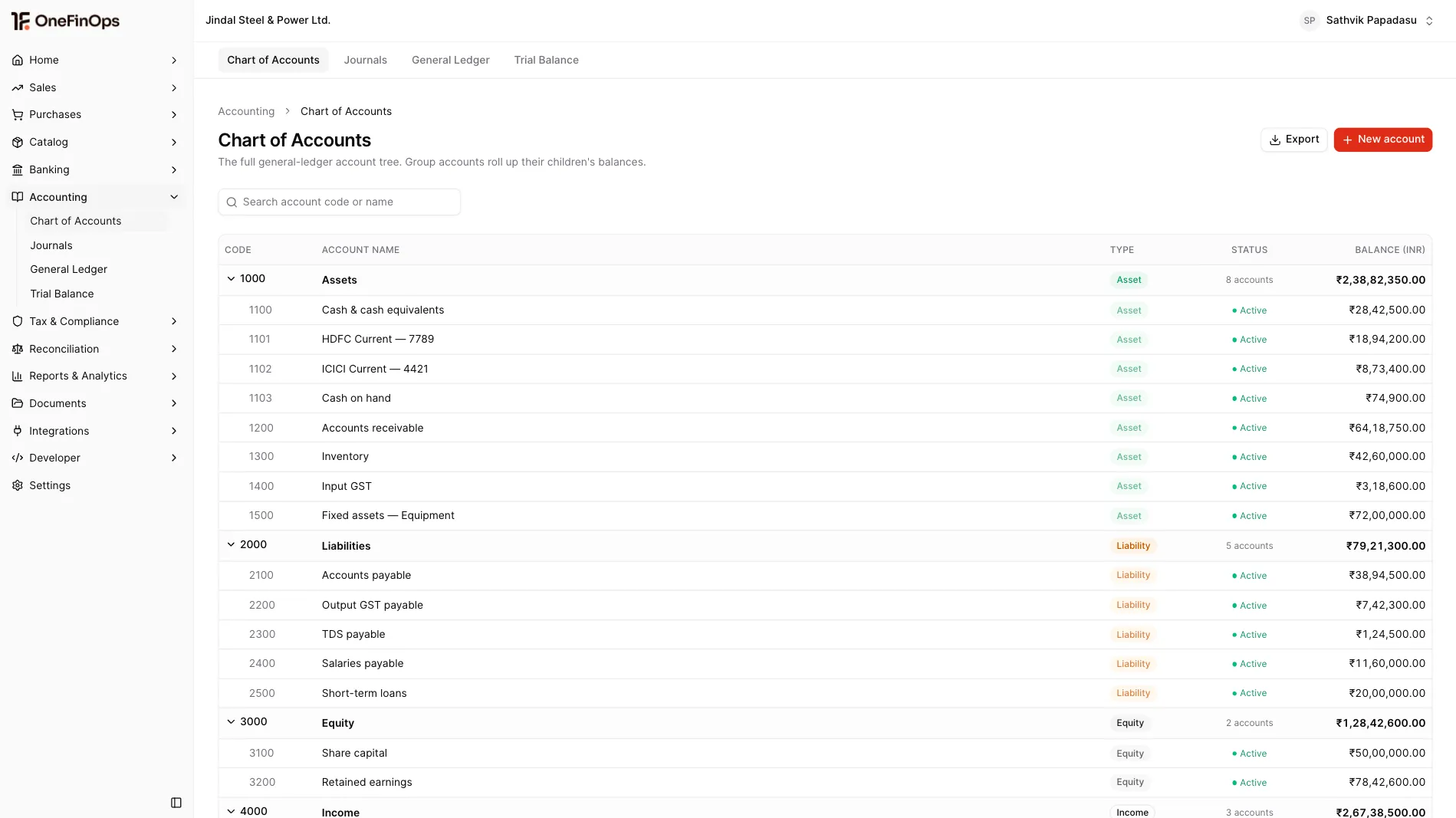
Chart of accounts, balances and the close checklist at a glance. Not a slide deck. The actual product.
Cloud accounting
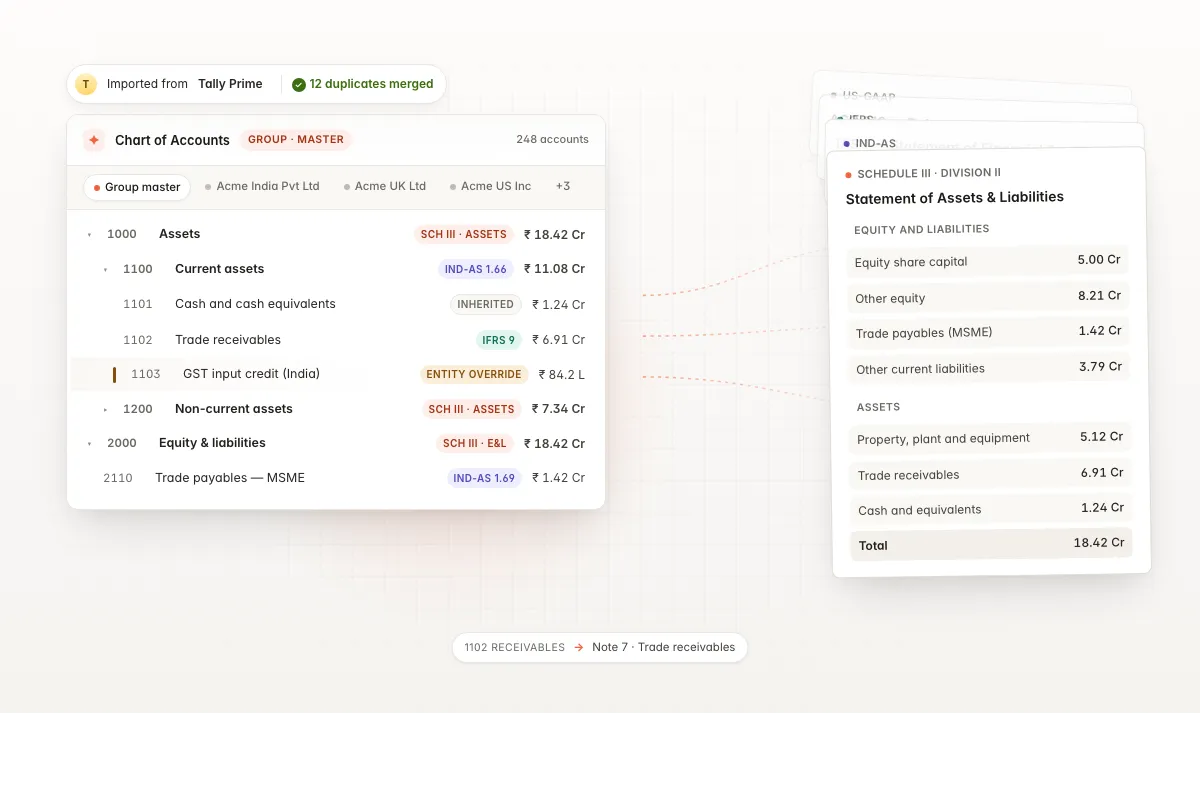
Define the COA at the group, let each entity inherit and override where local standards demand it. Schedule III, Ind-AS, IFRS and US-GAAP layouts ship with the product.
Every manual entry carries its source document. Recurring entries run on a schedule for accruals and provisions. Reversals post next period automatically.
Pre-built tasks for bank reconciliation, accruals, FX revaluation and intercompany. Owner per task, evidence per task, sign-off captured. The period locks when it turns green.
P&L, balance sheet and cash flow from the same ledger that ran operations. Drill from any line to the journal entry, and from there to the source bill or invoice.
Multi-entity, multi-country, multi-currency consolidation on one ledger. Intercompany eliminations apply inline. Indian subsidiaries roll up to foreign parents without a second ledger.
Functional currency per entity, transactions in 100+ currencies. RBI reference rates by default. FX revaluation runs at period end and posts realised and unrealised gains.
Companies Act useful-life depreciation for the books, Income Tax Act depreciation in parallel for tax. SLM, WDV and units-of-production. Disposals post the gain or loss inline.
Every change hash-chained and append-only, with user, role, IP and timestamp. Rule 11(g) covered out of the box. Evidence packs export hash-verified, accepted by Big Four firms.
Chart of accounts
Define the COA once at the group. Each entity inherits it and overrides only where local standards demand. Schedule III, Ind-AS, IFRS and US-GAAP layouts ship with the product, so an Indian subsidiary on Schedule III rolls up to a foreign parent on IFRS without a parallel ledger.
Multi-currency books
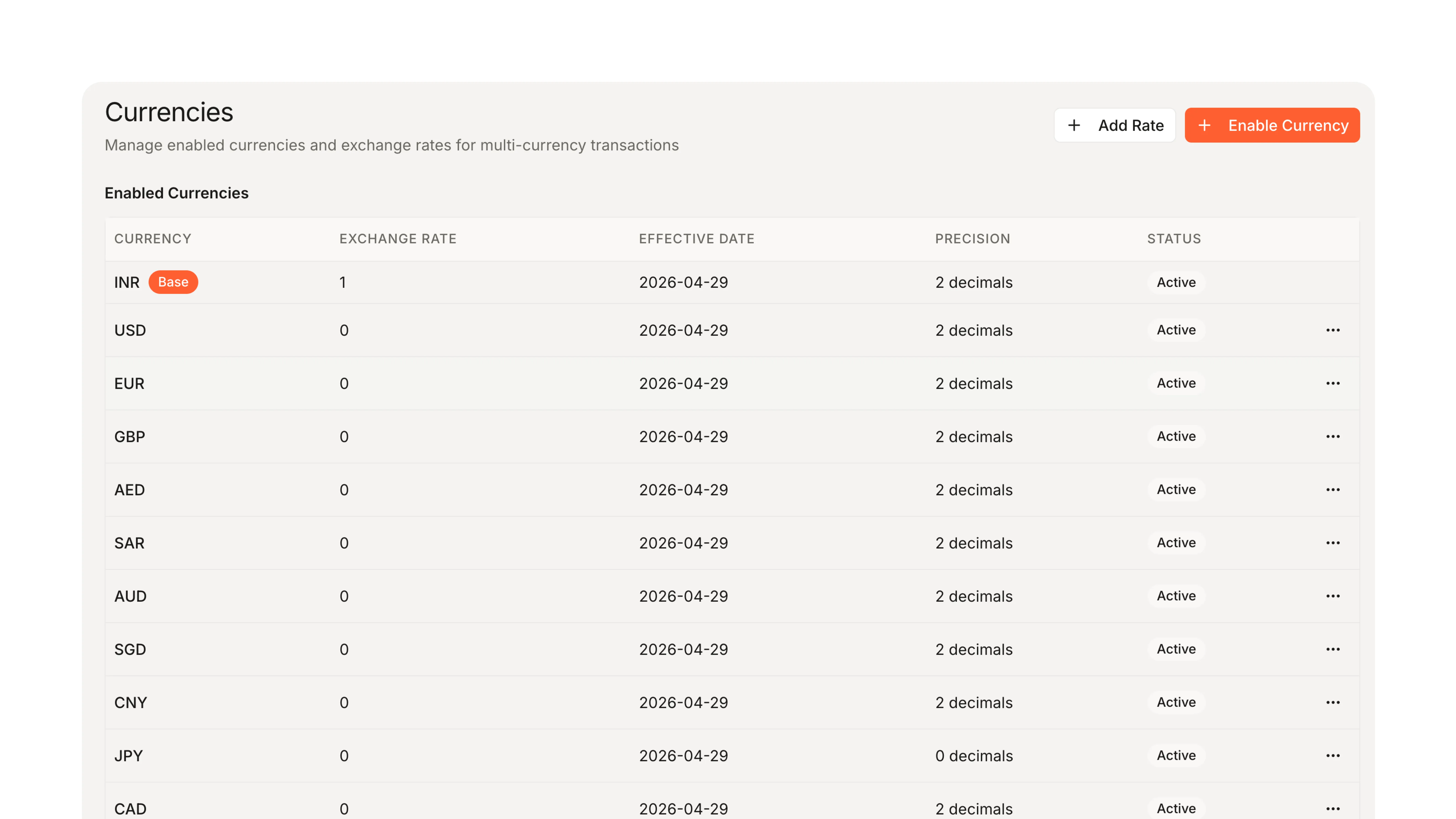
Functional currency per entity, transactions in any of 100+ currencies. RBI reference rates by default, custom sources where you need them. FX revaluation runs at period end and posts realised and unrealised gains automatically, so the books carry the right value on close day.
Exchange rates
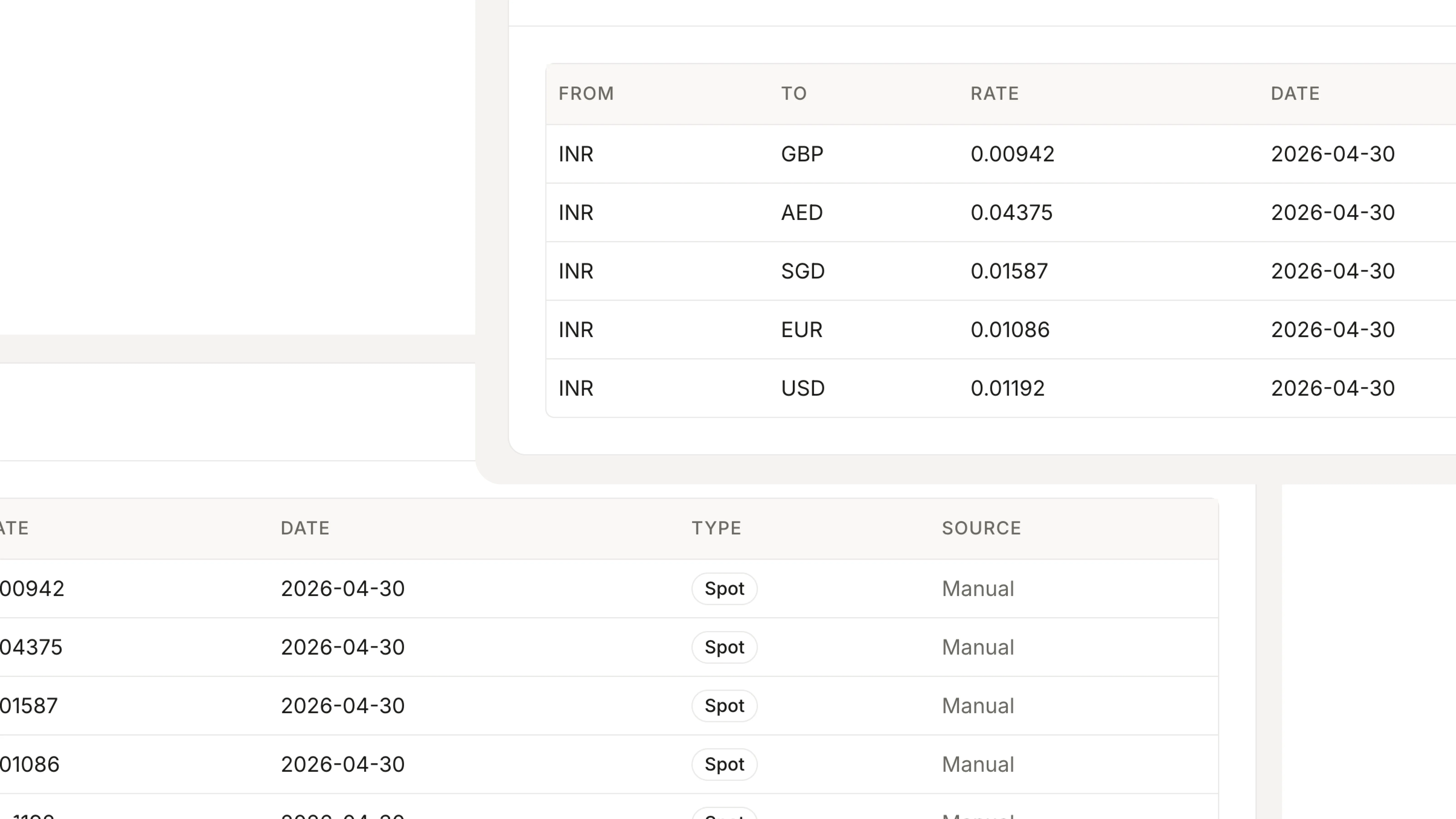
RBI reference rates load by default, with the full history retained per currency pair. Override with a custom source where a contract demands it. Each revaluation shows the rate it used and the gain or loss it posted, so the auditor sees exactly how the FX line was derived.
How it works
Import your COA, opening balances and historical entries with the audit trail intact. The validator flags rounding and duplicate masters before cutover.
Receivables, payables, payroll and tax post to one ledger. Every journal entry traces back to its source document.
Run the period-close checklist: reconciliations, accruals, FX revaluation and intercompany, each with an owner and evidence. The period locks when it is green.
P&L, balance sheet and cash flow drop the day you close, on Schedule III, Ind-AS, IFRS or US-GAAP. Drill any line back to the source.
At scale
median close cycle, post-rollout
journal entries linked to a source document
adjusting JEs in close week
Schedule III, Ind-AS, IFRS and US-GAAP, out of the box
Customer stories
Period closes that hold, audit trails that pass first review, and statements that drop the day the books lock.
Prasanthi Vijayagiri
Co-founder · EverUptime
As an early-stage team, we can't justify a finance back office. OneFinOps gives us clean, compliant books from day one.

Kshitiz Sachan
Founder · Tribe
We finally have one source of truth across AR, AP and compliance. The real-time visibility lets our team operate with confidence.

Sashi Pagadala
CEO · Praval
Coordinating finance and procurement used to eat hours every day. OneFinOps now saves our team nearly 18 hours a week.
Buyer FAQ
Yes. 14 days free, no credit card. Connect a Tally Prime backup, run the migration validator and watch your first demo close run on your own COA and close cadence before you commit to anything.
The migration tooling imports your COA, opening balances and up to 24 months of historical entries with the audit trail intact. A validation report flags rounding, FY misalignment and duplicate masters before any cutover. Most teams cut over in 2 to 3 weeks; multi-company setups or businesses with heavy custom TDLs take 4 to 8 weeks. The validation report at the end of week 1 tells you which path you are on.
Yes. Same ledger, multiple report layouts. Schedule III (Division I, II and III), Ind-AS, IFRS and US-GAAP ship with the product. Multi-GAAP per entity is supported, so an Indian subsidiary on Schedule III can roll up to a foreign parent on IFRS without a parallel ledger.
Yes. CA reviewer access is built in. Year-end finalisation, audit notes and DSC sign-off are captured per entity. Big Four audit packs export hash-verified, with the full audit trail attached.
Yes. Every change is hash-chained and append-only, with user, role, IP and timestamp captured per entry. The audit trail meets the Rule 11(g) requirement and is preserved for the 8-year retention window under Section 128. Auditors get read-only access without provisioning a regular user account.
Yes. Period lock is enforced at the entity level. Authorised users can post a reopen-and-adjust, captured with reason, approver and audit trail. Once a period has had a CA sign-off and DSC, the reopen workflow requires an explicit override with a justification on the record.
Yes. Multi-entity, multi-country and multi-currency consolidation is native. Intercompany eliminations and FX revaluation run inline. Indian entities consolidate on Schedule III, the UAE entity on IFRS, and the group view maps both to a single GAAP of your choice.
Indian customers’ data is hosted in India (Mumbai region) with replicas in Hyderabad. The platform is also available in EU, UK, US and Singapore regions for groups with non-Indian data residency requirements. Each region is a separate deployment; cross-region replication only happens when explicitly configured.
Connect a Tally Prime backup, free. Run the migration validator. The first demo close runs on your COA, your close cadence and your CA’s review pattern. On your data, not a sandbox.
14 days free · no credit card needed