Definition
What is an E-Invoice?
An e-invoice is a standardized digital invoice reported to the government’s Invoice Registration Portal (IRP) at the moment it is issued. The portal validates the invoice, assigns a unique Invoice Reference Number (IRN), and returns a digitally signed QR code that must be printed on the physical or PDF invoice.
Contrary to the name, businesses do not generate invoices on a government portal. They continue to use their own billing or ERP systems. E-invoicing is the act of reporting the invoice to the IRP in a standardized JSON schema.
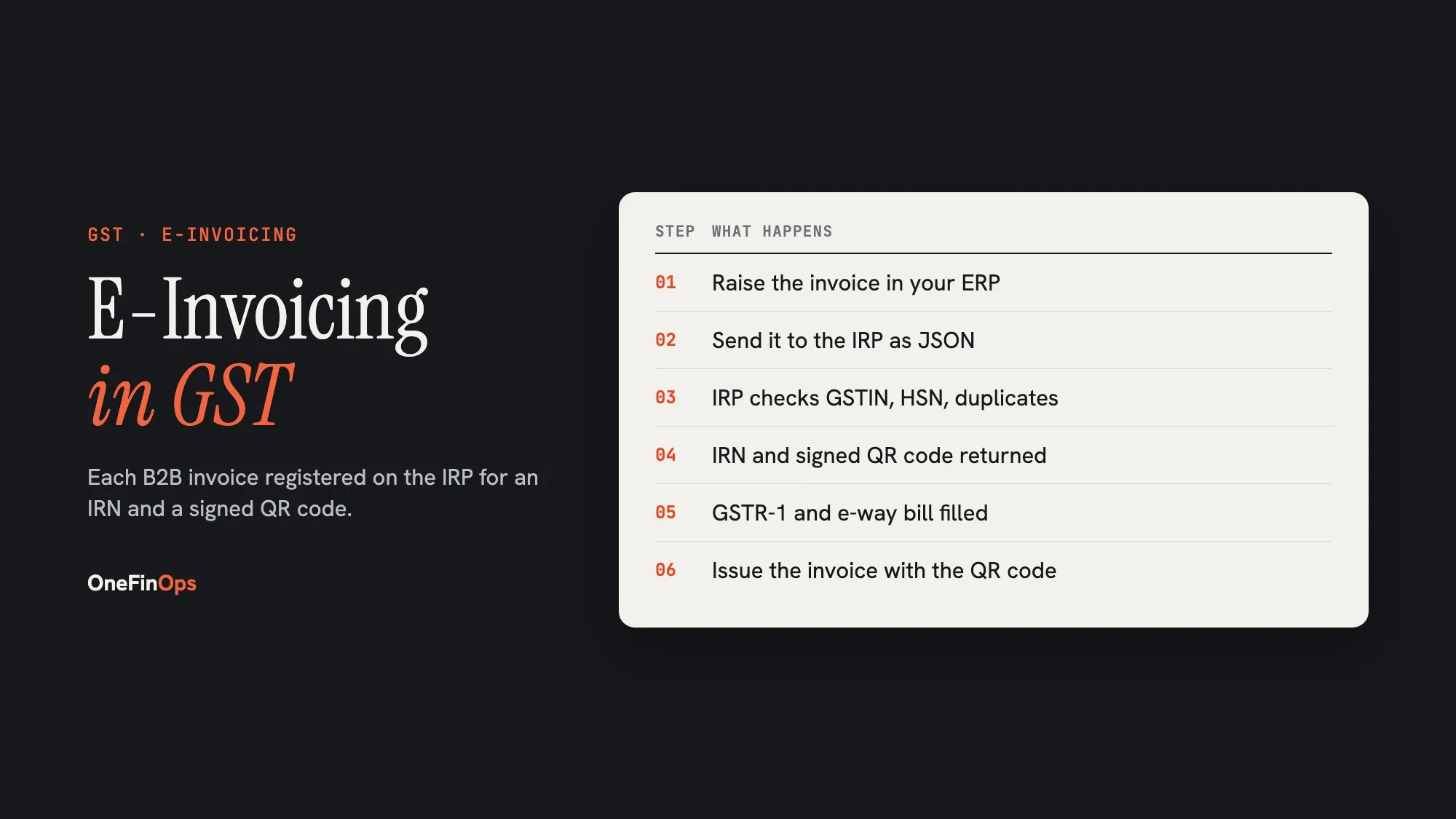
How e-invoicing works, step by step
- Raise the invoice in your billing or ERP system as usual.
- Convert to the e-invoice JSON schema and send it to the IRP, either directly or through a GST Suvidha Provider.
- The IRP validates and signs the invoice, returning the 64-character IRN and a digitally signed QR code.
- Print the QR code and IRN on the invoice you give the customer.
- Data auto-flows into your GSTR-1 and the buyer’s GSTR-2A / GSTR-2B.
Turnover threshold and rollout
The e-invoicing mandate has expanded in phases since October 2020, with the turnover threshold steadily lowered from Rs. 500 crore to Rs. 100 crore, Rs. 50 crore, Rs. 20 crore, Rs. 10 crore, and, from 1 August 2023, Rs. 5 crore. A business above the threshold in any financial year since 2017-18 must e-invoice its B2B supplies.
What is covered, and what is exempt
E-invoicing applies to B2B supplies, exports, supplies to SEZ, and the related credit and debit notes. It does not apply to B2C invoices. Some categories are exempt regardless of turnover, including banks and NBFCs, insurers, goods transport agencies, passenger transport services, cinema admission, and SEZ units acting as suppliers.
Cancelling, amending, and the 30-day rule
An IRN can be cancelled in full within 24 hours on the IRP; there is no partial cancellation and no amendment on the portal. After 24 hours, correct the position with a credit note rather than a cancellation. Separately, from 1 April 2025, taxpayers with aggregate turnover of Rs. 10 crore or more must report an invoice within 30 days of its date, so old invoices cannot be batched late.
Why it matters
Once an invoice is reported to the IRP, the data automatically flows into the supplier’s GSTR-1 and the recipient’s GSTR-2A / GSTR-2B. This eliminates manual data entry, removes a large class of ITC reconciliation mismatches, and shrinks the window for fake ITC claims.
E-Way Bill synergy
E-invoice JSON can carry transport details; when present, the IRP can auto-generate the corresponding E-Way Bill, collapsing two compliance steps into one.
Consequences of non-compliance
If the e-invoicing mandate applies to a supplier and they fail to generate an e-invoice, the document is legally invalid as a tax invoice. The recipient cannot claim ITC against it, and the supplier faces penalties under the CGST Act.