Definition
An E-Way Bill (Electronic Way Bill) is a compliance document generated on the GST E-Way Bill portal (ewaybillgst.gov.in) that must accompany the movement of goods worth more than Rs. 50,000 in value, whether for supply, reasons other than supply (such as job work), or inward supply from an unregistered person. Introduced under the GST framework through Rule 138 of the CGST Rules, 2017, the E-Way Bill system replaced the fragmented state-level waybill and transit pass requirements with a unified, digital solution applicable across the entire country. It consists of two parts: Part A (invoice details, goods description, HSN code, value, recipient details) and Part B (transport details including vehicle number).
The E-Way Bill must be generated before the commencement of movement of goods and has a defined validity period based on the distance to be covered. For regular vehicles (other than over-dimensional cargo), the validity is one day for every 200 kilometers or part thereof. For over-dimensional cargo, the validity is one day for every 20 kilometers. If goods cannot be transported within the validity period, the transporter or generator can extend the E-Way Bill before its expiry. The E-Way Bill can be generated by the consignor, consignee, or the transporter, and each bill is assigned a unique 12-digit E-Way Bill Number (EBN).
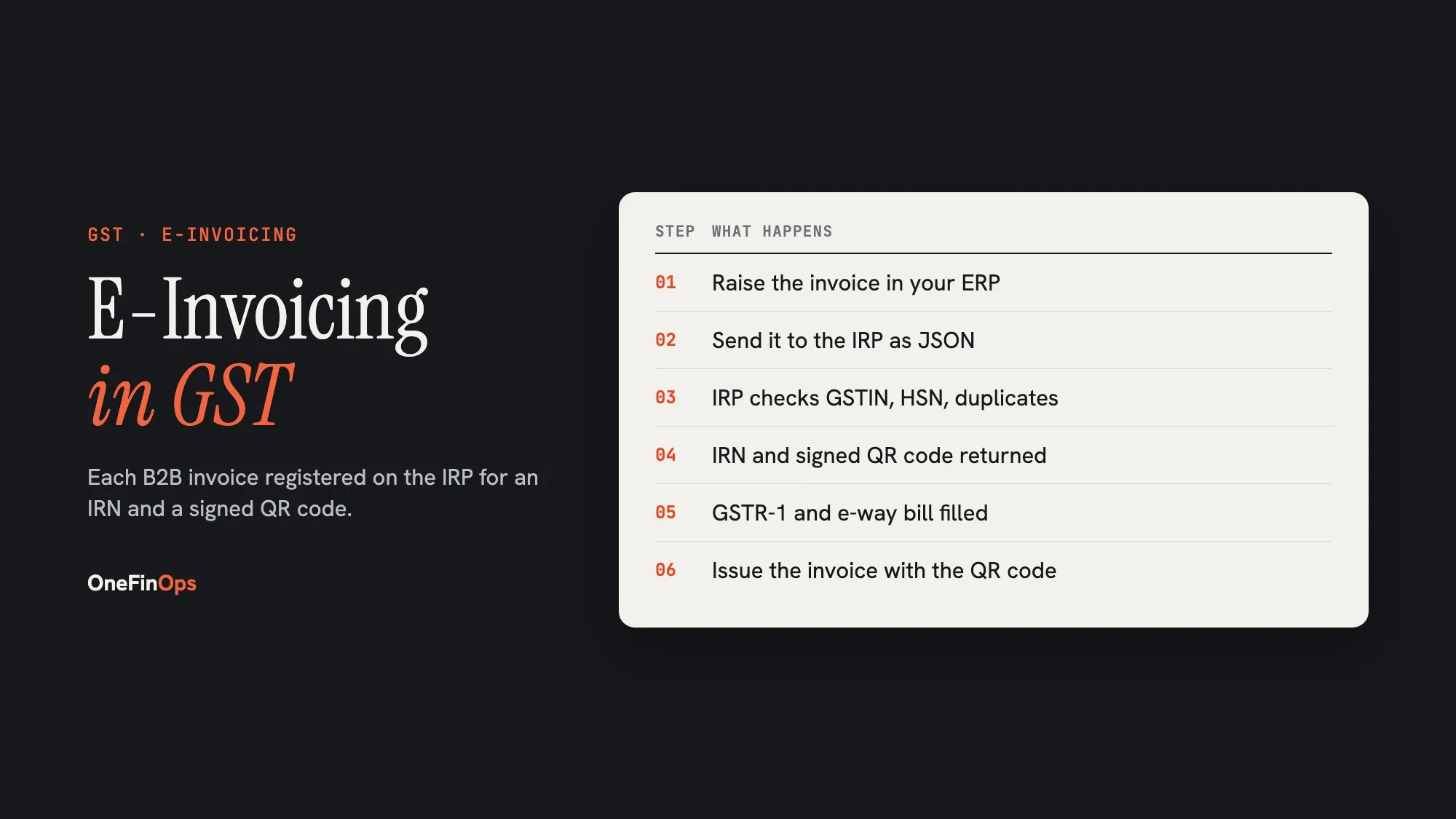
The E-Way Bill system serves as a powerful tool for the GST authorities to track the movement of goods in real time and prevent tax evasion. Transport officers can verify E-Way Bills at checkpoints by scanning the QR code or entering the EBN on the portal. Movement of goods without a valid E-Way Bill or with an expired E-Way Bill can result in detention of goods and the conveyance, along with a penalty equal to the tax amount or Rs. 10,000, whichever is higher. Businesses that generate E-Invoices can auto-populate Part A of the E-Way Bill from the e-invoice data, requiring only the transport details (Part B) to be added separately, thereby reducing duplicate data entry and improving compliance efficiency.
Key Points
-
Mandatory for movement of goods worth more than Rs. 50,000, generated on the E-Way Bill portal with a unique 12-digit EBN.
-
Validity is distance-based: one day per 200 km for regular vehicles, extendable before expiry if goods cannot be delivered in time.
-
Consists of Part A (invoice and goods details with HSN codes) and Part B (transport and vehicle details).
-
Movement without a valid E-Way Bill attracts detention of goods and penalty equal to the applicable tax amount or Rs. 10,000, whichever is higher.
-
E-Invoice integration allows auto-population of Part A from e-invoice data, requiring only Part B transport details to be added manually.