


Information Reporting | Backup Withholding
The one case where you do hold cash back.
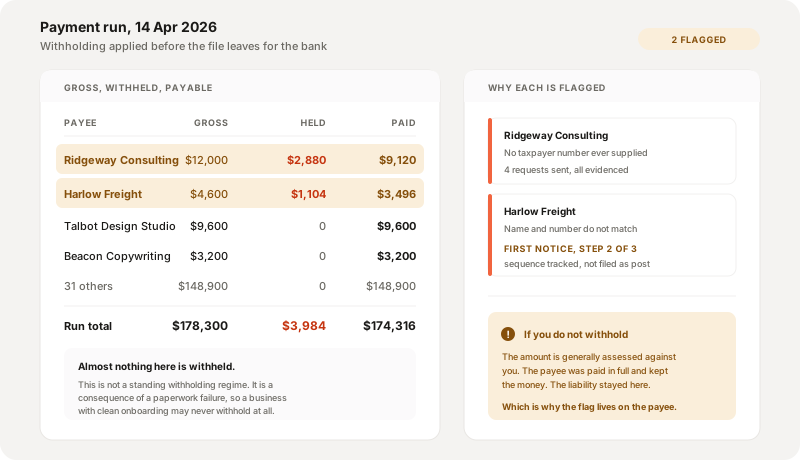
Almost nothing in US vendor payments is withheld. This is the exception, and it is triggered by a paperwork failure rather than by the kind of payment: a payee who never gave you a taxpayer number, or one the IRS has told you does not match. If you should have withheld and did not, the amount is generally recoverable from you, not from them.
What the system does
Capability, input, output.
| Capability | Input | Output |
|---|---|---|
| Trigger on the payee | A missing or mismatched taxpayer number | The payee flagged as subject to withholding, before the next payment run |
| Apply at payment | A payment to a flagged payee | The withheld amount computed and separated from the amount payable |
| Notice handling | An IRS notice about a payee | Recorded against the payee, with the required follow-up tracked rather than filed |
| Solicitation record | Requests sent to the payee for a correct number | Evidence of having asked, held with dates, which is what the process requires |
| Release | A corrected taxpayer number that matches | The flag lifted from the date it should lift, not retroactively |
| Deposit and reporting | Amounts withheld through the period | The withheld total tracked for deposit and carried onto the payee's form |
-
Trigger on the payee
- Input
- A missing or mismatched taxpayer number
- Output
- The payee flagged as subject to withholding, before the next payment run
-
Apply at payment
- Input
- A payment to a flagged payee
- Output
- The withheld amount computed and separated from the amount payable
-
Notice handling
- Input
- An IRS notice about a payee
- Output
- Recorded against the payee, with the required follow-up tracked rather than filed
-
Solicitation record
- Input
- Requests sent to the payee for a correct number
- Output
- Evidence of having asked, held with dates, which is what the process requires
-
Release
- Input
- A corrected taxpayer number that matches
- Output
- The flag lifted from the date it should lift, not retroactively
-
Deposit and reporting
- Input
- Amounts withheld through the period
- Output
- The withheld total tracked for deposit and carried onto the payee's form
Backup Withholding FAQ
What buyers ask.
How often does this actually apply?
For a business with clean vendor onboarding, close to never, and that is the point. Nothing about paying US vendors withholds by default. This exists only as a consequence of an identity step that did not happen, so the number of payees in scope is a direct measure of how well the onboarding control is working.
What actually happens if we should have withheld and did not?
The amount can generally be assessed against you, which is the part that surprises people. You paid the vendor in full, the vendor kept the money, and the liability for the amount you should have held back sits with you. That asymmetry is the reason the flag lives on the payee rather than in someone's memory.
What is a B notice?
A notice telling you that a payee name and taxpayer number you reported do not match what the IRS holds. It starts a defined sequence with required actions and timing, and the sequence differs depending on whether it is the first such notice for that payee or a subsequent one. Recorded against the payee with its follow-up tracked, rather than treated as correspondence.
What rate applies?
A single flat rate, and it is configured rather than printed in our copy, because it has changed and could change again. Your advisor or your payroll provider will have the current figure. The part the software owns is knowing which payees are in scope and applying whatever rate you set, consistently, at the payment run.
Can we just not pay the vendor until they send a W-9?
Often the better answer, and many teams set it up that way, which is why the flag is visible in the approval flow rather than only at payment. Holding a payment while a vendor wants to be paid is the moment you have the most leverage to get the form, and the moment costs nothing to use.
See which payees would trigger withholding today.
Connect your books, free. Payees are checked against the forms and numbers you hold, and the ones at risk come back ranked by spend.