


OneFinOps vs Chargebee
Subscription billing, on the same platform as your books.
Chargebee is a strong, focused billing engine. OneFinOps runs the same recurring and usage-based billing, then posts every invoice to your ledger as the system of record, so revenue, tax and the books never live in a second system.
Your digital finance team, working around the clock with evidence, and gated on whatever moves money.
- CODrafting reminders for 3 overdue accountsWorkingCollections1m
- APPay Steelline Components, above your limitNeeds approvalAccounts Payable₹4.2 L
- GCGSTR-3B prepared for April, ready to reviewDoneGST & Compliance22m
- RCMatched ₹18.4 L receipt to INV-2043DoneReconciliation1h
- PVVendor bank-detail change on Acme heldNeeds reviewVendor Compliance2h










The TL;DR
Chargebee bills. OneFinOps bills and books, on one platform.
Chargebee does subscription billing well and hands an invoice to whatever system keeps your books. OneFinOps keeps billing and the ledger together: the same engine bills the subscription and posts the invoice to receivables, so revenue recognition, tax and cash all reconcile without a sync.
Billing plus the books
- ✓ Recurring and usage-based billing on one engine
- ✓ Every cycle posts an invoice to receivables
- ✓ Revenue recognition on the same ledger
- ✓ Tax and statutory e-invoicing on the billing invoice
- ✓ AP, expenses, banking and reporting included
Focused billing engine
- · Mature, deep subscription billing feature set
- · Large catalog of third-party integrations
- · Revenue recognition available as an add-on
- · Books and tax live in a separate system
- · Pricing scales with your billed revenue
Side by side
Feature-by-feature comparison
Subscription billing, how revenue hits the books, tax and invoicing, and the platform around it.
| Feature | OneFinOps | Chargebee |
|---|---|---|
| Subscription billing | ||
| Recurring billing, all cycles | ||
| Usage-based and metered billing | ||
| Tiered, volume and stairstep pricing | ||
| Proration on mid-cycle plan changes | ||
| Dunning, smart retries and hosted card update | ||
| Revenue and the books | ||
| Each billing cycle posts an invoice to your GL | Connector | |
| Revenue recognition on the same ledger | Add-on | |
| One source of truth for revenue | ||
| General ledger and accounting in the platform | ||
| Tax and invoicing | ||
| Tax computed by the books on one invoice | Integration | |
| Statutory e-invoicing on the billing invoice | Via partner | |
| Multi-country tax | ||
| Platform | ||
| AP, expenses, banking and reporting in one platform | ||
| Dedicated billing depth and integration catalog | Core set | |
| Self-serve checkout and customer portal | ||
The platform
Eight products. One record.
Receivables, payables, accounting, vendors, procurement, compliance, catalog and the e-invoicing API. Click through to see what each one does and how the flows connect.
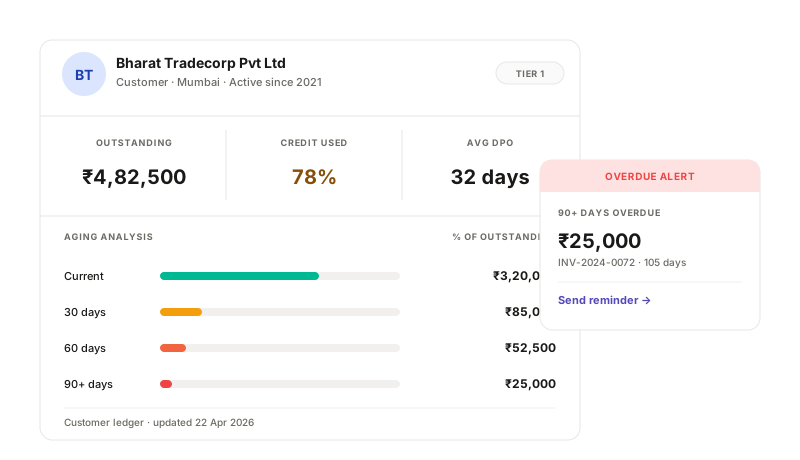
From quote to cash. Without the chasing.
Quote, sales order, invoice, delivery note, receipt, credit note. All on the same record. Aging, dunning and credit limits computed in real time.
Key flows
- Quotes, sales orders & invoicing
- GST invoicing & e-invoicing (IRN)
- Customer 360, aging & DSO
- Payment links & UPI collection
- Credit limits, dunning & reminders
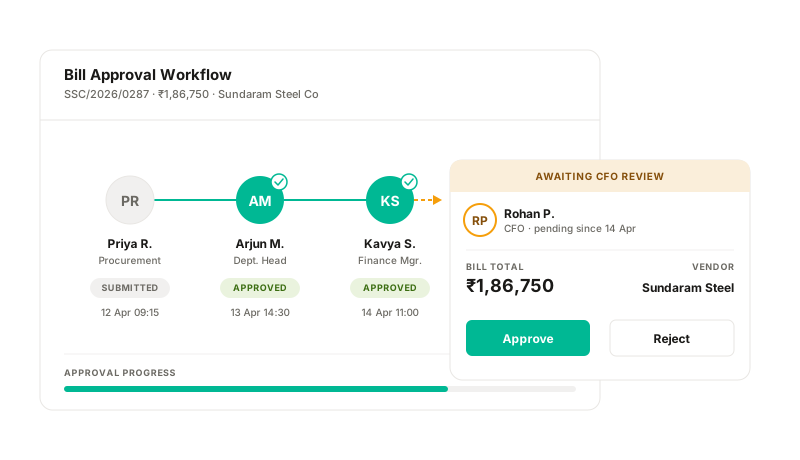
Bill to bank. With controls baked in.
Vendor bills, 3-way matching, line-item TDS and bank payment batches on the same record. Approvals run on rules, not WhatsApp threads.
Key flows
- Bill capture (OCR) & approvals
- GSTR-2B reconciliation & ITC
- Line-item TDS & 26Q
- Vendor payment batches & banking
- MSME 43Bh & RCM bills
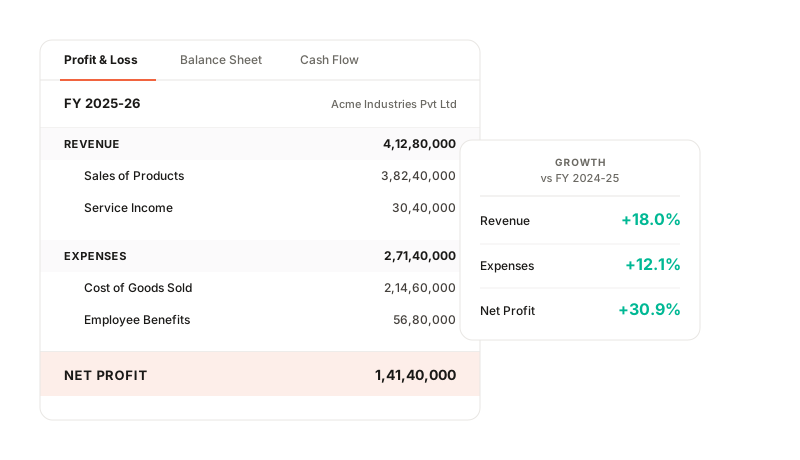
Double-entry books your auditor expects.
Multi-entity, multi-currency books on one chart of accounts. Period locks, audit trail and financial statements that compute themselves.
Key flows
- Chart of accounts & journals
- Multi-entity consolidation
- Multi-currency books
- Period close & audit trail
- Fixed assets & depreciation
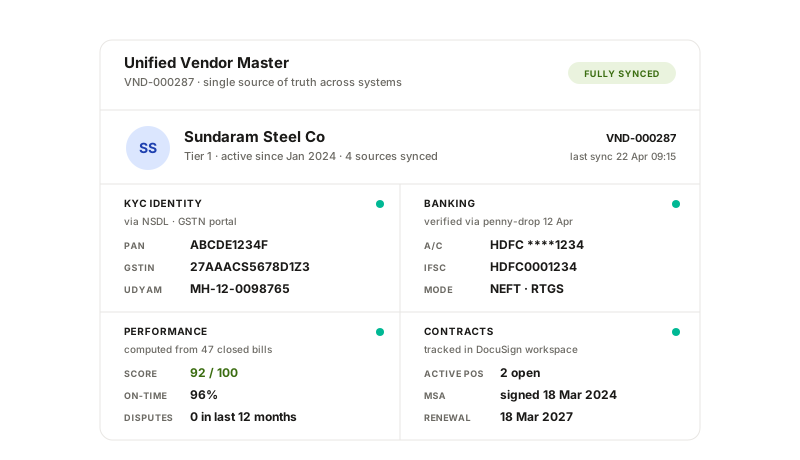
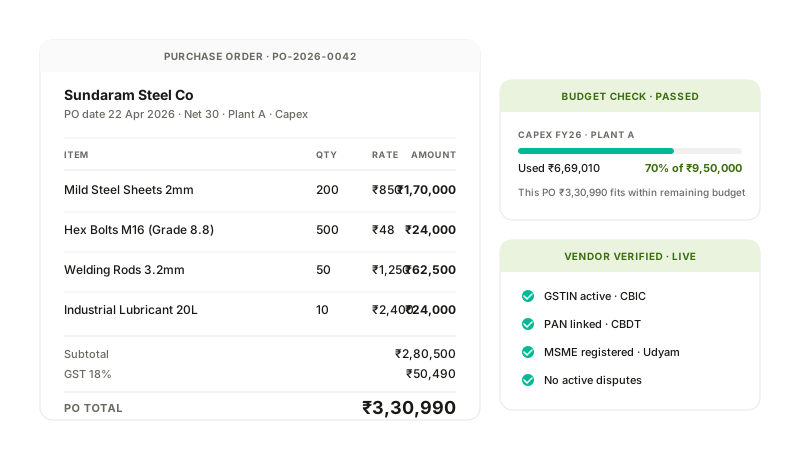
One vendor record. Verified, scored, ready to pay.
Bills, POs, payments, contracts and KYC posture on one vendor record. GSTIN, PAN, MSME and Udyam verified live. Risk scored across filing posture, payment behaviour and concentration.
Key flows
- Unified vendor master
- Self-service onboarding & KYC
- GSTIN, PAN, MSME, Udyam checks
- Risk scoring & performance
- Section 195 foreign vendor TDS
Requisition to receipt. With vendor controls.
POs, GRNs, contract purchasing and budgets on one record. Vendor onboarding runs through KYC, GSTIN and risk scoring.
Key flows
- Purchase requisitions & POs
- Goods receipt notes (GRN)
- 3-way matching & budgets
- Vendor master, KYC & GSTIN
- Vendor risk & performance scoring
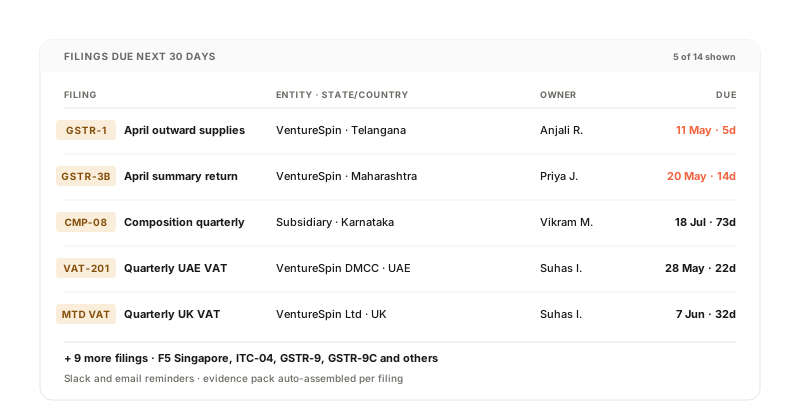
Filings computed from the books.
GST, TDS, MCA and payroll statutory filings as by-products of doing the books. Not a parallel system to reconcile every quarter.
Key flows
- GST filings (GSTR-1, 2B, 3B, 9, 9C)
- TDS deduction, challans & Form 16/16A
- MCA / ROC filings (AOC-4, MGT-7, DPT-3)
- Payroll compliance (PF, ESI, PT, LWF)
- Multi-country tax engines
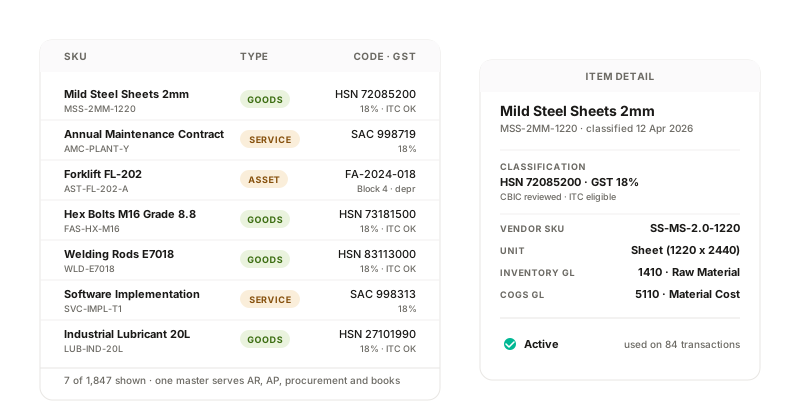
Items, inventory and pricing on one master.
Items, SKUs, units and price lists with HSN/SAC auto-classified. Multi-warehouse inventory, kits and BOMs included.
Key flows
- Items, SKUs & barcodes
- HSN / SAC auto-classification
- Price lists & customer pricing
- Kits, bundles & BOMs
- Inventory & multi-warehouse
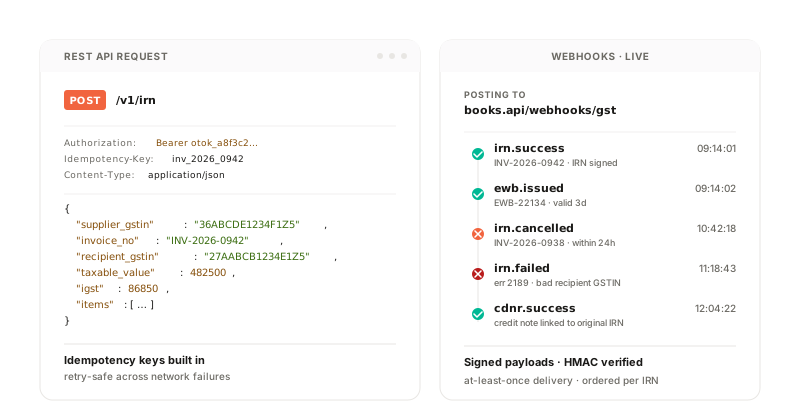
Drop e-invoicing into your ERP.
Direct GSTN integration over a clean REST API. Generate IRNs and e-way bills from any system. No portal logins, no manual filing, no glue code to own.
Key flows
- IRN generation
- E-way bill creation & extension
- Bulk operations
- E-invoice cancel & amend
- Multi-GSTIN management
- Reconciliation
What Chargebee does well
Honest take: when to stay on Chargebee.
Chargebee is a mature, billing-focused platform with a deep feature set and a large integration catalog. If billing is the only job to be done and your accounting, tax and revenue recognition already live in a system you are happy with, a dedicated engine is a reasonable choice.
- You only need billing, and your books live elsewhere
- You rely on specific Chargebee integrations or its ecosystem
- Your finance stack is settled and you are not consolidating tools
- Billing-specific depth matters more than a single platform

Compare FAQ
Buyers ask.
What is the core difference between OneFinOps and Chargebee?
Chargebee is a standalone billing engine: it bills the subscription and hands an invoice to whatever system keeps your books. OneFinOps runs the same billing, then posts each cycle to receivables as the system of record. Revenue recognition, tax and cash sit on the same ledger, so there is no sync to reconcile and no second source of truth for revenue.
Does OneFinOps match Chargebee on billing features?
For the common cases, yes: all recurring cycles, usage-based and metered billing, tiered, volume and stairstep pricing, proration on plan changes, coupons, dunning with smart retries, and a hosted update-card page. Chargebee has a longer tail of billing-specific features and a larger third-party integration catalog, which is worth weighing if you depend on a specific one.
How does revenue recognition compare?
In Chargebee, revenue recognition is an add-on module that produces schedules you then reconcile to your accounting system. In OneFinOps, recognition runs on the same ledger that holds the invoice, derived from the subscription term, so deferred and recognised revenue post on the right period and tie out to the books under IFRS 15, ASC 606 and Ind-AS 115 without a transfer step.
Can we migrate our Chargebee catalog and subscriptions?
Yes. The catalog models product families, plans, add-ons, prices, tiers and entitlements the same way Chargebee does, so plans map field for field. Active subscriptions, customers, payment methods and renewal dates come across so billing continues on the same cycle.
How does pricing compare?
Chargebee typically prices as a percentage of the revenue you bill above a threshold, so the cost grows with your top line. OneFinOps prices on the platform rather than taking a cut of your revenue, and billing comes bundled with the rest of the finance modules. Which is cheaper depends on your volume, so the honest answer is to compare on your own numbers.
Do we lose anything by consolidating billing into our finance platform?
You trade a longer tail of billing-only features and integrations for one source of truth across billing, revenue, tax and the books. For teams whose main pain is reconciling a separate billing tool with their ledger every month, that trade is the point. For teams that need a specific Chargebee capability, a dedicated engine may still fit better.
See billing post to the books, end to end.
A 30-minute walkthrough that bills a subscription, posts the invoice to receivables, collects the charge and recognises the revenue. Or start free and try it on your own plans.