
Item Master & Pricing
One item master, used everywhere.
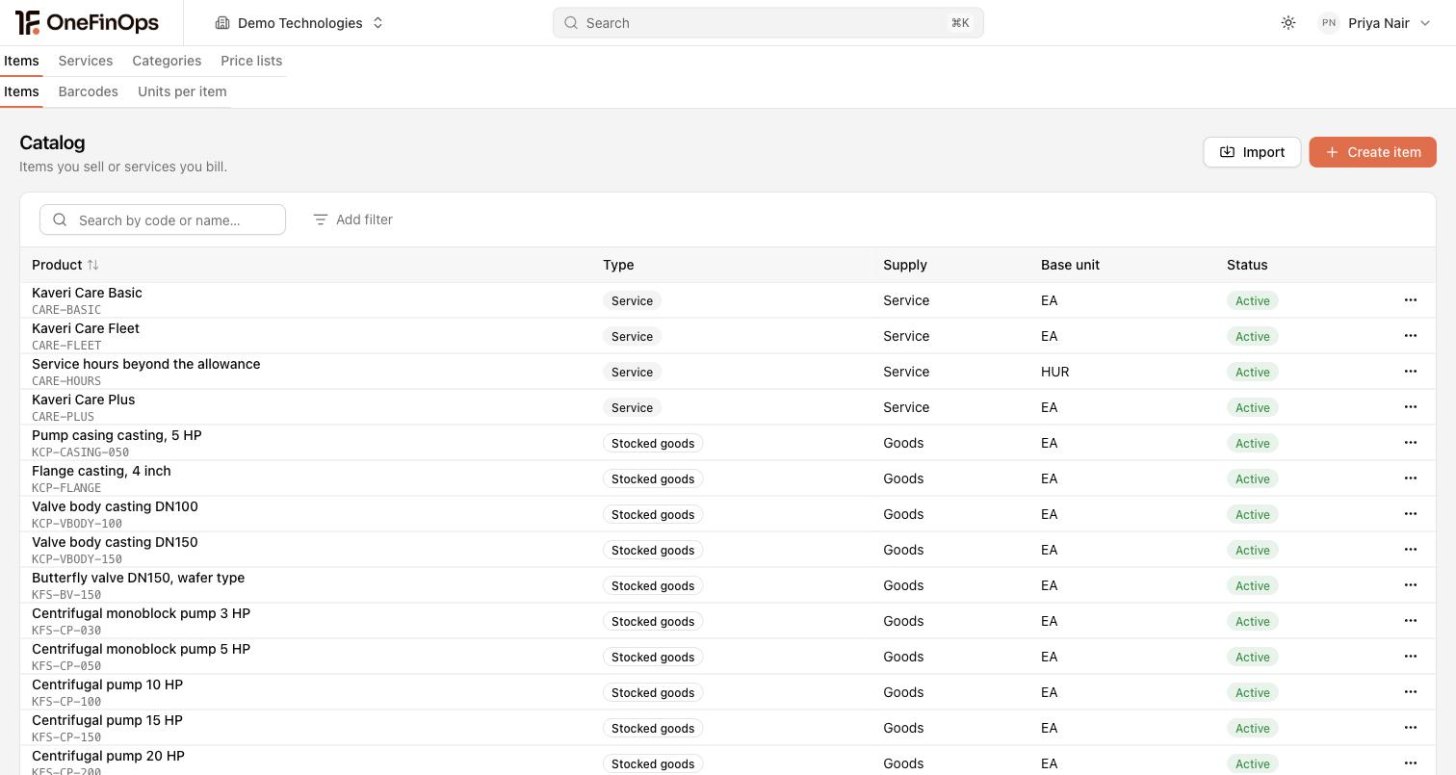
Items, SKUs, HSN/SAC and price lists on one master. AR, AP, procurement, inventory and the books all post against it. HSN and SAC classified against the live CBIC master.
Items & SKUs
One SKU. The right tax and GL by type.
Items defined once with internal SKU, vendor SKU and lifecycle status. Goods carry HSN; services carry SAC; fixed assets link to the asset register. The same master serves AR, AP, procurement, inventory and the books, with item-type-aware tax behaviour throughout.
HSN Code Finder
HSN classified against the CBIC master, not your guess.
Live search against the CBIC HSN master. AI suggests against your historical mappings. Rate, ITC eligibility, exemption notifications and rate-change history all surface per code. Reviewer approves, classification locks, audit trail captures the choice.
SAC Code Finder
SAC classified against the CBIC master.
Service Accounting Codes searched against the live CBIC SAC master. Rate, exemption notification and place-of-supply rule per service. Inter-state vs intra-state treatment surfaced. Reviewer approves, classification locks per service.
Units of Measure
Order in cartons. Invoice in pieces. Post in kilograms.
Primary, secondary and conversion factors per item. The PO uses one unit, the customer invoice another, the books a third. Conversion runs automatically. The audit trail captures the unit at every transaction.
Item Groups & Categories
Hierarchical groups. Bulk edits roll down. Reports roll up.
Item groups in a hierarchy: category, sub-category, item. Bulk edits at the group level (price-list change, HSN reclassification, GL remap) roll down to all items. Reports roll up to any level. Approval routing rules can target a group.
Price Lists & Discount Engine
Price lists that pick themselves at the line.
Customer, region, channel, currency, date and quantity-tier dimensions. The right rate selects automatically at quote, sales order and invoice time. Date-effective overrides for promotions. Approval-routed customer-specific overrides. Audit trail per change.
Customer-Specific Pricing
Customer overrides without the spreadsheet sprawl.
Per-customer rate overrides sit on top of the master price list. Overrides are approval-routed, rationale captured, expiry-date enforced. The strategic-customer rate sheet that lived on someone's desktop now lives in the system, with the audit trail intact.
Barcode Management
EAN, UPC, QR. One catalog, every code.
Barcode generation per SKU (EAN-13, UPC-A, Code 128, QR for variant or batch). Print sheets for retail labelling. Scan at receipt, transfer, dispatch and POS. One scan, the right item, no typing, no drift.
Bulk Import & ERP Sync
CSV in. ERP synced. E-commerce in step.
CSV and Excel bulk import with line-level validation. Bidirectional sync with Tally Prime, Zoho Books, SAP B1 and NetSuite. E-commerce sync with Shopify, Amazon Seller Central and Flipkart Seller Hub. POS integrations for retail. The master is one, every system stays in step.
Kits, Bundles & BOM
Bundle, kit or BOM. The right model per item.
Bundles for sales packaging (sell as one, ship as components). Kits for substitutable assemblies. BOM for light manufacturing consumption. Each model captures component cost roll-up, GST treatment and stock movement correctly.
Buyer FAQ
What teams ask before they switch.
We sell goods, services and fixed assets. Does that work?
Yes. Item types are first-class with the right tax and GL behaviour per type. Goods carry HSN, services carry SAC, fixed assets link to the asset register and the depreciation schedule. The same master serves AR, AP, procurement, inventory and the books.
How does HSN and SAC AI classification work?
AI suggests classifications against the live CBIC master plus your organisation's historical mappings. Confidence is shown per item; the tax reviewer approves before the classification locks. The model learns from your overrides over time.
Can we have customer-specific pricing on top of a master price list?
Yes. Customer overrides sit on top of regional or channel base lists. Currency converted at the rate of your choice (live RBI reference rates or pinned). Date-effective overrides handle promotional pricing without breaking the audit trail.
Does it support kits, bundles and BOM-style assembly?
Yes. Bundles with component rollup, kit items with optional substitution, and simple BOM for light manufacturing. For heavy manufacturing setups (multi-stage routing), the BOM lives in your MRP system; the finished goods post to OneFinOps.
Can our CA pull HSN and SAC summaries for audit?
Yes. The HSN summary report (mandatory in GSTR-1) generates automatically per quarter and per FY. Item-wise, quarter-wise, with ITC matched at the SKU level. The CA reviewer accesses it read-only without a regular user account.
How are GST rate changes handled when the law shifts?
CBIC rate notifications trigger a master refresh. Affected items surface for review. The new rate applies prospectively from the notification date. Historic transactions retain the rate at posting. The audit trail captures the rate-change event.
Multi-currency price lists. Which rate is used?
The price list rate stored in the foreign currency is used as the base. Conversion to INR uses the rate at the transaction date (RBI reference rate by default; pinned forward rates supported for groups with treasury hedging policies).
Bring 50 items. See the HSN classification, the price list, the GST rate, all on screen.
Connect one entity, free. Upload 50 SKUs from your existing system. The HSN auto-classification runs, the price list applies, the GST rate is right at the line. Compare to your current master.