Multi-entity consolidation
Each entity owns its books, currency and tax engine. Group view consolidates with FX translation, intercompany elimination and minority interest.

Multi-entity consolidation, SAML SSO, SCIM, audit log exports, custom reports, 24x7 SLA and a named CSM. Built for groups running across countries and operating units.
At enterprise scale, every line on the security review and procurement form is non-negotiable. We have signed off on hundreds.
Each entity owns its books, currency and tax engine. Group view consolidates with FX translation, intercompany elimination and minority interest.
India (GST/TDS), UAE (VAT/CT), Singapore (GST), US (sales tax/1099), UK (VAT/MTD), EU (VAT/OSS). Each country owns its own engine.
Identity federation with Okta, Azure AD, Google Workspace, OneLogin. SCIM for user provisioning and de-provisioning.
Every action logged. Streamed to your SIEM (Splunk, Datadog, Sumo Logic). Retention configurable per regulation.
Drag-and-drop report builder, REST + GraphQL APIs, Snowflake/BigQuery sinks, scheduled email/Slack delivery.
A dedicated customer success manager, a solution engineer for new rollouts, 24x7 incident response with severity SLAs.
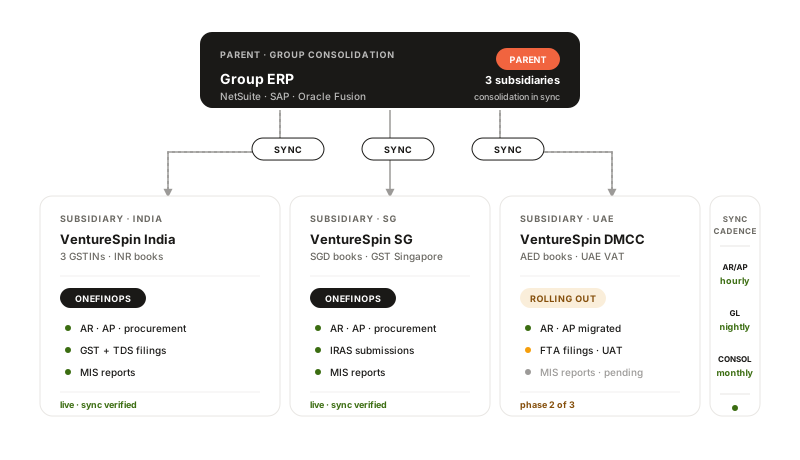
Many groups run NetSuite or SAP at the parent for group consolidation and reporting. OneFinOps sits in operating subsidiaries as the AR, AP, procurement, compliance and reports layer. Bidirectional integration keeps the parent in sync; local subsidiaries get a faster, cheaper, country-aware platform.
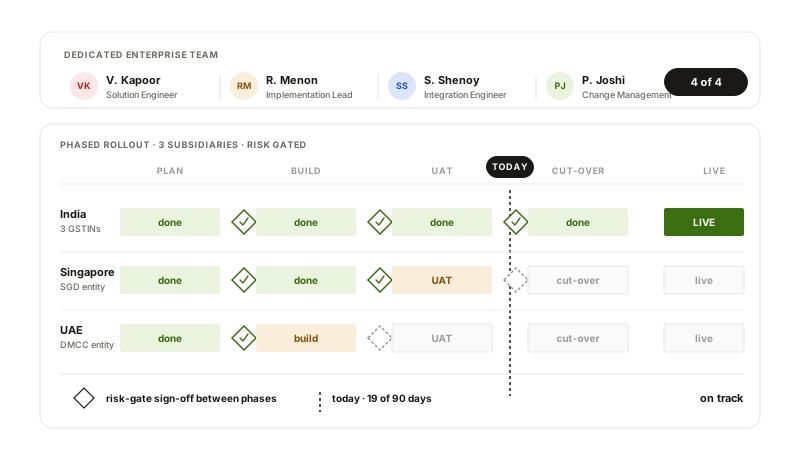
Enterprise rollouts get a dedicated solution engineer alongside the implementation lead. Custom workflows, integrations to non-standard systems, data migration from legacy ERPs, change management for the finance org. The 30-day go-live runbook is tuned per group.
Data is hosted in regional clouds aligned to local data residency rules: India-resident data on Indian regions (per DPDP), EU on EU regions (per GDPR), UAE on regional regions, etc. Each tenant is isolated. Cross-border transfers are explicit and logged. Encryption at rest and in transit, key management via KMS with per-tenant keys.
SOC 2 Type II report (audited annually by a Big-Four firm) and ISO 27001 certificate available under NDA via the Trust portal. Penetration test summaries, architecture overviews and SDLC documentation provided as part of the InfoSec review. Customer-specific security questionnaires (CAIQ, SIG) supported.
Scale tier includes 99.95% platform uptime, 24x7 incident response with severity-based response times (Sev 1: 30 min response, 4-hour resolution target). Maintenance windows pre-announced. Status page at status.onefinops.com. Service credits per the MSA on SLA breach.
SAML 2.0 SSO with Okta, Azure AD, Google Workspace, OneLogin and any compliant IdP. SCIM 2.0 for user provisioning, de-provisioning and group sync. JIT user creation. Multi-IdP federation supported (different subsidiaries on different IdPs).
Single-tenant private cloud deployments are supported on Scale tier for groups with strict data sovereignty requirements (defence, BFSI, government). On-premise deployments are case-by-case via the enterprise architecture team.
Custom MSA, scoped to your entities, countries, modules, integrations and SLA. Multi-year commitments unlock dedicated infrastructure, named team and custom roadmap. Talk to sales for a quote.
Per-line-item, per-edit audit trail with source documents linked. Period locks with approval-gated reopens. Segregation of duties enforced via role-scoped permissions. ICFR-aligned controls documented per workflow. Customer auditors get a scoped, time-bound view.
A scoping call with our solution engineer, a security review pack on day two, an MSA on day five. We move at procurement speed, not sales speed.