










Ruchita
CFO · Absolute Labs
After moving to OneFinOps, our approval turnaround dropped 63% and finance operations got far easier to manage.
The workforce
Each one owns an outcome and works the task end to end. Start with one, add more as you grow. They run on your books, so every action is grounded in the same ledger your team and auditor already trust.
Ranks overdue accounts by risk and value, drafts and sends personalised reminders, logs promises to pay and escalates disputes. Brings DSO down.
See the workMatches every bill three ways, flags duplicates and risky vendors, prepares payment batches and holds anything that looks wrong.
See the workOnboards and verifies vendors, collects the W-9 before the first payment, scores risk on document expiry, bank-detail changes and concentration, and tracks POs through to receipt.
See the workWatches the trial balance and GL, drafts journal entries with their basis shown, and tracks period-close readiness day by day.
See the workMeasures nexus against every state as you sell, drafts state sales tax returns from your books, and tracks 1099 readiness per payee all year rather than in January.
See the workFinds what does not tie across bank, books and supplier statements, resolves the exceptions it can and flags the breaks it cannot.
See the workConsolidates cash, risk and runway across the workforce and assembles the monthly board and MIS pack.
See the workBuilt to be trusted with your ledger
A digital agent is not a chatbot that drafts and forgets. It runs real work to completion, under guardrails you set.
Work runs across hours and days, survives restarts, pauses for an approval and resumes exactly where it left off. No dropped tasks, no double actions.
Every figure is pulled from your ledger by deterministic code, never invented. The agent writes the narrative, your system of record holds the numbers.
Anything that moves money or files a return waits for a human. Maker-checker by default, with full context and evidence on every decision.
Start every agent assisting, drafting for review. Graduate it to act on operational work, then to autonomous within the limits you set. Audited end to end.
The platform underneath
Your digital agents act on one connected platform. Receivables, payables, accounting, vendors, procurement, compliance and catalog, all on one shared record. Click through to see what each surface does.
Quote, sales order, invoice, delivery note, receipt, credit note. All on the same record. Aging, dunning and credit limits computed in real time.
Key flows
Vendor bills, 3-way matching and approvals on the same record as the vendor. Approvals run on rules rather than email threads, and approvers are not charged for.
Key flows
Multi-entity, multi-currency books on one chart of accounts. Period locks, audit trail and financial statements that compute themselves.
Key flows
Bills, POs, documents and contracts on one vendor record, not in a second system kept in sync with the first. W-9 collected before the first payment, taxpayer number matched, bank details re-checked when they change.
Key flows
POs, receipts, contract purchasing and budgets on one record. Vendor onboarding runs through document checks, bank-detail control and risk scoring.

Key flows
Sales tax, 1099 and entity filings as by-products of doing the books. Not a parallel system to reconcile every quarter.

Key flows
Items, SKUs, units and price lists with the right taxability per item type and per state. Multi-warehouse inventory, kits and BOMs included.
Key flows
Multi-entity, multi-country
Each agent runs with your entity's state profile, currency and filing calendar. One team across every entity you operate, on the same shared ledger.
Built for the whole finance org
Each role gets digital agents for the repetitive work and a live dashboard tuned to what their boss is going to ask.
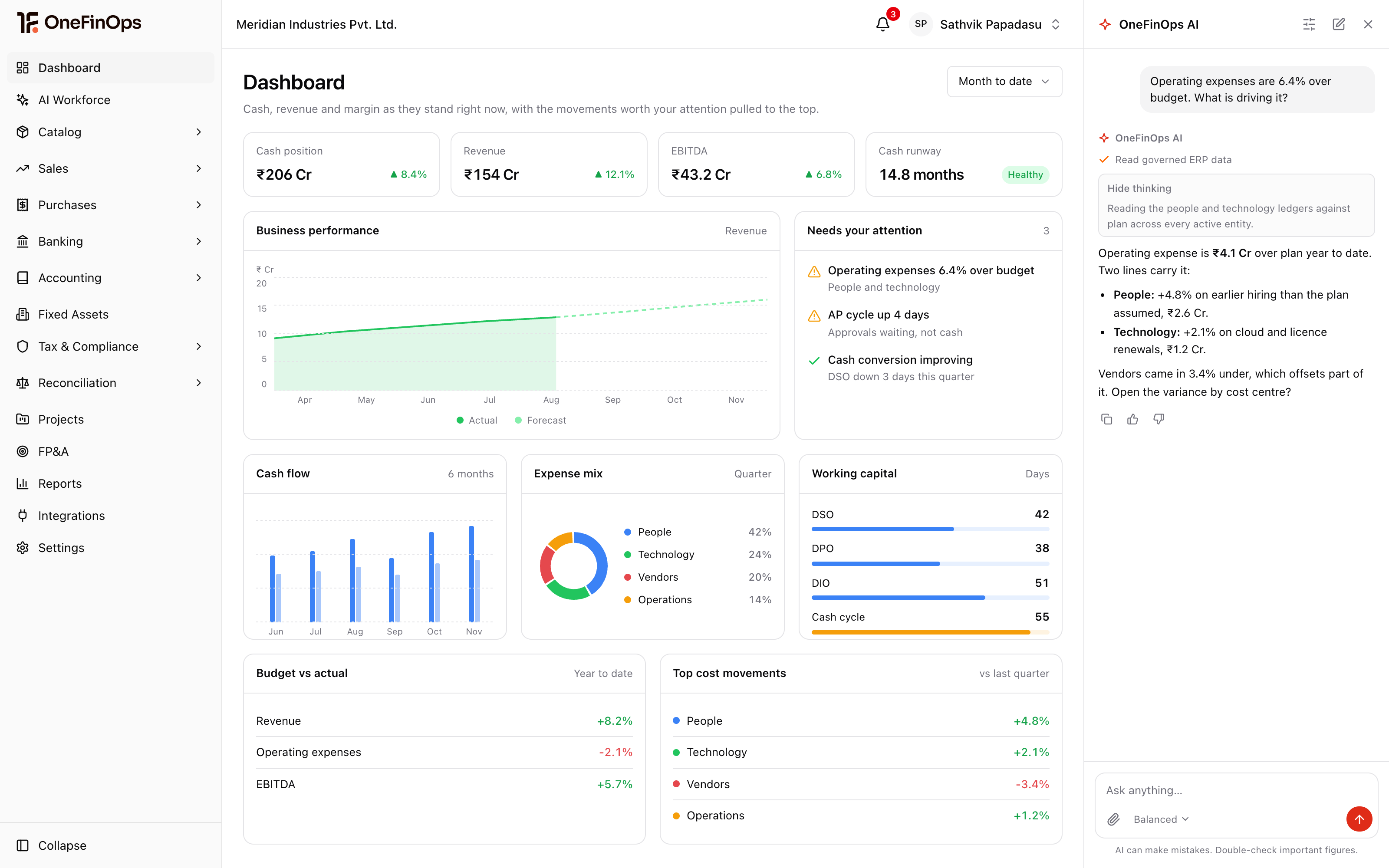
Cash position, runway, financial ratios, working-capital health, and the one-screen view that walks straight into board meetings.
Close the books in days, not weeks. Audit trail, period locks, role-scoped data, and the recon checkpoints your auditor expects.
DSO, aging, dunning and smart reminders that nudge before invoices slip past due.
3-way match queue, vendor risk, approvals, and the variances most teams miss.
Nexus tracked as you sell, state filing calendar, 1099 readiness per payee, and alerts before a notice arrives.
By the numbers
Digital finance agents
Collections, payables, vendors, accounting, reconciliation and more
Always on the clock
Durable tasks run overnight and resume after any interruption
Figures traced to your ledger
Every number pulled from your books, never invented
From assist to autonomous
Raise each agent's autonomy as your confidence grows
Customer stories
Finance leaders running real operations on OneFinOps, in their own words. Faster close, cleaner audits, fewer end-of-month surprises.
Ruchita
CFO · Absolute Labs
After moving to OneFinOps, our approval turnaround dropped 63% and finance operations got far easier to manage.
Prasanthi Vijayagiri
Co-founder · EverUptime
As an early-stage team, we can't justify a finance back office. OneFinOps gives us clean, compliant books from day one.
Sashi Pagadala
CEO · Praval
Coordinating finance and procurement used to eat hours every day. OneFinOps now saves our team nearly 18 hours a week.
Kshitiz Sachan
Founder · Tribe
We finally have one source of truth across AR, AP and compliance. The real-time visibility lets our team operate with confidence.
FAQ
The questions buyers actually ask, on the first call.
OneFinOps is a finance platform with a team of digital agents built in. The agents act: they chase overdue invoices, match vendor bills, prepare your filings, post draft journal entries and reconcile your books, all on one connected platform that runs your accounting, receivables, payables, procurement and compliance. Your people set the autonomy, approve anything that moves money, and stay in charge.
A chatbot answers a question and stops. A digital finance agent takes on a job and finishes it. It works a task end to end across hours or days, calls real actions in your finance system, waits for an approval where it needs one, and produces an audit trail for everything it did. You hire it into a role, like Collections or Accounts Payable, and it owns the outcome.
Both, and you choose. Every agent starts in assist mode, where it drafts everything for a human to approve. You can graduate it to act on operational work on its own, and then to autonomous within limits you set per agent. Anything that moves money or files a return stays gated behind a human approval until you decide otherwise.
Agents run as durable tasks. A single job can send a reminder, wait for a reply, escalate on day three and log the payment, all in one continuous flow. If a server restarts or a step fails, the work resumes exactly where it left off, without repeating an action it already took.
Two things, and neither is the model. Every figure is pulled from your ledger by deterministic code rather than generated, so an agent cannot invent a number even if it wanted to. And anything that moves money or files a return waits for a human approval by default. The agent decides what to do; it does not decide what is true, and it does not decide what is allowed.
Not in the US, and we would rather you heard that here than on the second call. Approved bills export as an ACH file for your bank or push to your ERP, and your bank moves the money. Most teams find this cheaper: platforms that execute payments charge per ACH and per check, and your own bank does the same transfer for a fraction of that or bundles it free. We take no cut of the payment, hold no float, and you onboard no new banking relationship.
If paying from inside the tool is your requirement, those are good products and you should look at them. What none of them does is vendor management: onboarding, documents and their expiry, contract renewals, performance and spend, all against the same vendor record the invoice runs on. Teams needing both end up with two contracts, two implementations and a vendor master that has to be kept in sync between them.
You can. Most teams that try it end up matching invoices in one system, tracking vendors in another, chasing receivables in a third, and hoping the numbers agree. OneFinOps runs them on one record. Every invoice, payment, receipt and expense flows into the same ledger that drives your reporting, your aging and your cash position. No nightly syncs, no quarter-end clean-up, no gaps between tools.
Flat tiers by volume, published, and not per seat. That matters more than it sounds: when approvers cost money, teams ration seats and approvals drift back into email, which is the thing you were trying to fix. Adding an approver, an entity or a viewer does not change your bill.
Yes. QuickBooks and Xero are live connectors, and onboarding covers migration with historical data, masters, opening balances and in-flight invoices and bills. Many teams keep their books exactly where they are and run AP and vendor management through OneFinOps. A dedicated implementation lead runs the cutover.
That is the case this is built for. Nexus is measured against every state as your invoices are raised, so you hear about an obligation from your own books rather than from a notice. Exemption certificates sit against the customer with their expiry, and state returns draft from the invoices behind them. We are not a rate engine and do not replace Avalara or TaxJar; we hold the position and the evidence around them.
One organisation, many entities. Each has its own currency and tax profile, files its own returns, and rolls up into consolidated reporting with translation and eliminations handled in the report. Adding an entity takes one screen and is not priced as an upgrade.
We prepare them from your books and validate them against the source ledger, then hand them to your accountant or in-house team ready to file, with the evidence pack attached. The signature stays with your authorised signatory. What we take off you is the preparation and the evidence, not the accountability.
OneFinOps is SOC 2 Type II certified and ISO 27001 aligned. Data is encrypted at rest with AES-256 and in transit with TLS 1.3, and tenants are isolated. The platform runs in several regions; each region is a separate deployment and every access is audit-logged.
A dedicated implementation lead, ERP migration via native connectors, historical data migration up to 36 months, vendor and customer master cleanup, integration setup and a 30-day go-live runbook. Most teams are running in 14 days.
A 5-person startup uses the same product as a 5,000-person group. Modules turn on as you grow. Pricing scales with entities, countries and seats, not with the modules you can see. No artificial gating to push you upmarket.
Start with Collections or Accounts Payable, keep them in assist mode while you watch, and dial up autonomy when you are ready. 14 days free, no credit card. Want a tour first? Book a 30-minute walkthrough tailored to your finance team.