Skip to content

Inventory Management

Live stock. Live books. One movement.

Receipts, transfers, dispatches and BOM consumption post to stock and the GL in the same transaction. Stock in a truck is accounted for, and valuation ties to the books on every movement.

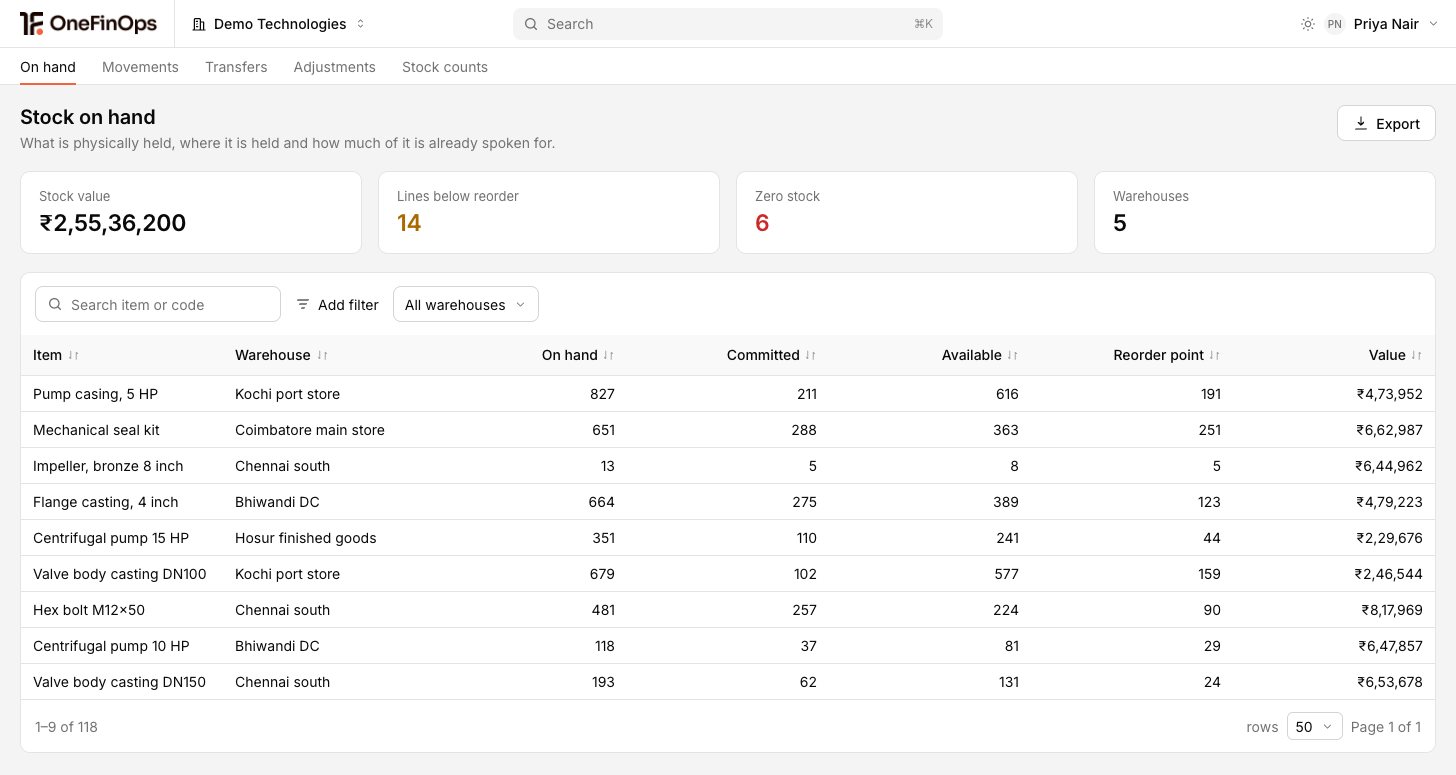
Stock on hand across warehouses with reorder flags and a stock valuation

Trusted by operations teams

  • PathoGenie
  • Sharada Agro Industries
  • SRF Capital
  • Absolute Labs
  • CultSet
  • Lead with Tribe
  • GehnaERP
  • Beacon
  • Praval
  • EverUptime

Live Stock Levels

Stock that updates the moment it moves.

Receipts, issues, transfers, BOM consumption and dispatches post to stock and the GL in the same transaction. The number you see at 11:47 AM is the number on the floor at 11:47 AM, not the close-of-day batch.

Live Stock Levels screenshot

Batch Tracking

Batch FIFO, expiry alerts, recall traceability.

Every receipt creates a batch with manufacture date, expiry and supplier batch number. Issues run FIFO automatically. Expiry alerts fire by configurable lead time. Recall reports trace any batch from receipt to dispatch in one query.

Batch Tracking screenshot

Serial Number Tracking

Per-unit traceability for service, warranty and recall.

Each serialised unit carries its identity from receipt to dispatch to service. Warranty starts at the customer-recognised date. Service history attaches to the serial. Recall trace runs at the unit level, not the batch.

Serial Number Tracking screenshot

Reorder Points & Auto-PO

POs drafted before the shelf is empty.

Min, max and reorder thresholds per item. Lead time and safety stock from your vendor performance history. Auto-PO drafts against approved vendors when stock crosses the threshold. Procurement reviews and releases. The shelf never runs dry.

Reorder Points & Auto-PO screenshot

Multi-Warehouse Transfers

Warehouse transfers and GL in one event.

A transfer posts the in-transit GL at dispatch and reverses it on receipt, so stock in a truck is never stock in two places or neither. Shrinkage variance is flagged with a reason code rather than absorbed quietly. No side calculations.

Multi-Warehouse Transfers screenshot

Goods in Transit

In-transit, visible. Loss-in-transit, accounted.

Goods between branches sit in the in-transit register with vehicle, distance and ETA. Receipt closes the loop. Variance posts to the loss-in-transit GL with reason capture. Period-end reconciliation surfaces aged in-transit positions.

Goods in Transit screenshot

Stock Valuation

FIFO or weighted-average, on every movement.

Choose the valuation method per item category or warehouse: FIFO, weighted average, standard cost or specific identification. GL posts on every movement; period-end reconciles to the inventory ledger within tolerance. The method you chose is the method the auditor sees, per category.

Stock Valuation screenshot

Cycle Counts & Adjustments

Cycle counts that don't freeze the warehouse.

Zone-based, ABC-class-based or item-category-based cycle counts. Only the cycled items lock; the rest of the warehouse stays operational. Adjustments post with reason codes. Every adjustment carries its reason and its audit trail.

Cycle Counts & Adjustments screenshot

Manufacturing BOM

BOM consumption, work order, finished-goods receipt.

Bill of materials defined per finished good. The work order issues components from raw material stock. Finished goods receive on closeout. Scrap and rework variance captured. Heavy MRP stays in your existing system; OneFinOps handles the books and inventory side.

Manufacturing BOM screenshot

Inventory Reports

The reports your CFO and your auditor actually ask for.

Stock summary, slow-moving and dead-stock reports, ABC analysis, item ledger, valuation reports, days-of-inventory by category. Exports as PDF, Excel and CSV. Auditor read-only access by period.

Inventory Reports screenshot

Buyer FAQ

What teams ask before they switch.

Can we run cycle counts without freezing operations?

Yes. Cycle counts run by zone, category or ABC class. The count locks only the cycled items, not the whole warehouse. Reconciliation posts the variance with a reason code, so the adjustment carries its explanation rather than appearing as an unexplained write-off.

Does it support manufacturing, BOM and work orders?

Light manufacturing is supported: BOM consumption at issue, finished-goods receipt at closeout, scrap and rework variance captured. For multi-stage routing and capacity planning, the MRP system stays where it is and the finished goods post here.

How is stock valuation kept consistent with the books?

Every stock movement posts a GL entry in the same transaction, so there is no nightly sync to reconcile. Period-end stock valuation ties to the inventory GL by construction rather than by spreadsheet.

Does it integrate with WMS, 3PLs and e-commerce platforms?

Yes. CSV and API connectors, with event hooks for receipts and dispatches so the warehouse and the books stay in step. Marketplace and POS integrations keep stock accurate across channels.

We hold stock across the region. Does that work?

Yes. Warehouses can belong to different entities in different countries, each with its own currency and tax rules, on one item master. A transfer between them posts the in-transit GL and settles the intercompany leg without a second system.

Walk through your last week of movements on screen.

Connect one warehouse, free. Post a receipt, a transfer, a dispatch, and watch the GL post in real time. The reconciliation gap from your existing system surfaces in the first hour.