
Accounting Software
Cloud accounting software.
Close the books in days, not weeks.
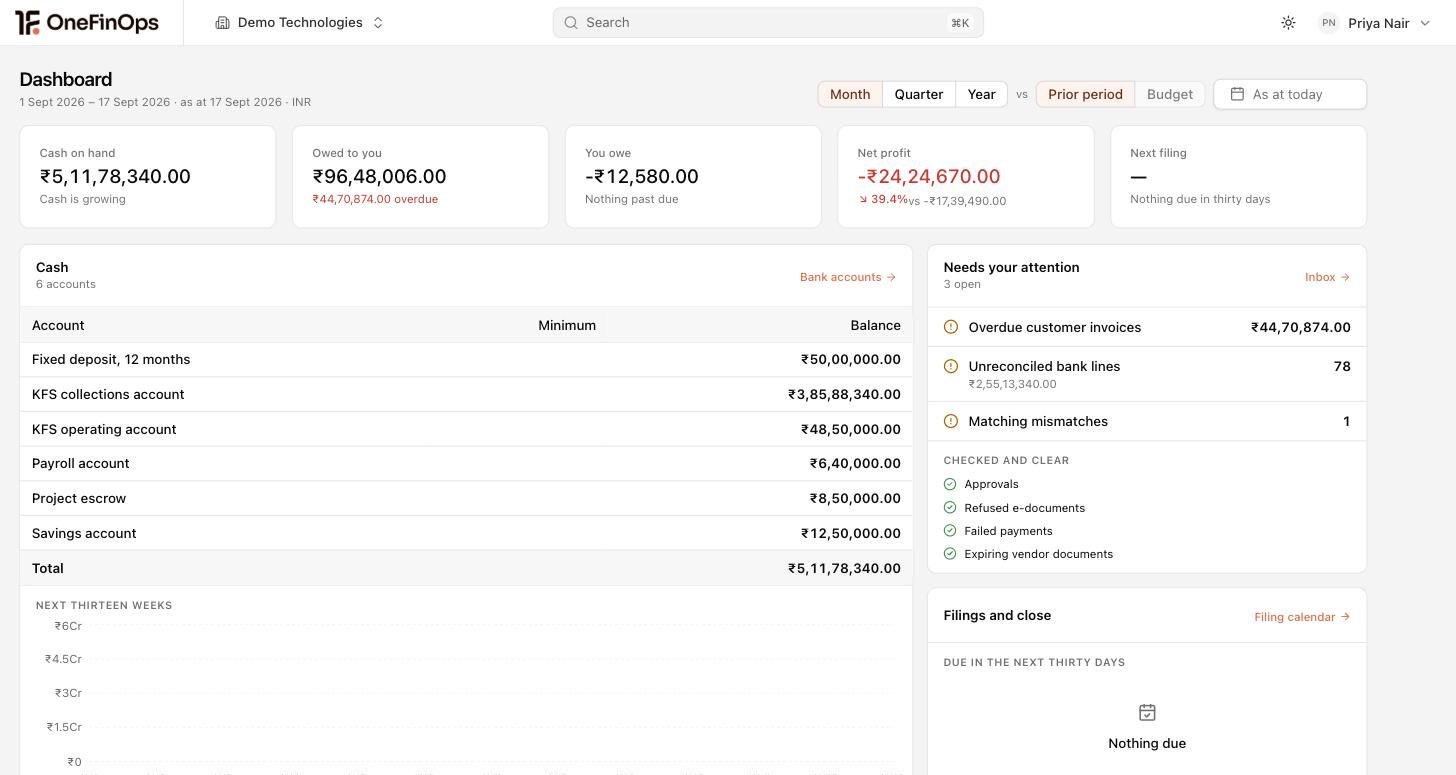
Receivables, payables, payroll and tax post to the same ledger across every entity and country. Period close runs on a checklist. Statements drop the day you close.
Trusted by finance teams
Chart of Accounts
One chart of accounts across every entity.
Define the COA at the group, let each entity inherit and override where local standards demand it. SFRS, IFRS and US-GAAP layouts ship with the product. Imports run in one screen, with duplicates merged before they reach your books.
Journal Entries
Every journal entry, traced to its source.
Manual entries carry the source document. Recurring entries run on a schedule for monthly accruals and quarterly provisions. Reversals post the next period automatically. Approvals enforce materiality thresholds. Period locks hold.
Period Close Checklist
Close the books on a checklist.
Pre-built tasks for bank reconciliation, accruals, FX revaluation, intercompany and tax matching. Owner per task, evidence per task, sign-off captured. The period locks when the checklist turns green.
Financial Statements
Statements drop the day you close.
P&L, balance sheet and cash flow generated from the same ledger that ran your operations. SFRS, IFRS and US-GAAP layouts. Direct or indirect cash flow. Drill from any line to the journal entry, and from there to the source bill or invoice.
Multi-Entity Consolidation
Consolidation built into the ledger.
Multi-entity, multi-country, multi-currency consolidation runs on the same ledger. Intercompany eliminations apply inline. FX translates at closing, average or historical rates. A Singapore holding company rolls up its regional subsidiaries without a second ledger.
Multi-Currency Books
One ledger across every currency.
Functional currency per entity. Transactions in any of 100+ currencies, with the rate source you choose. FX revaluation runs at period end and posts realised and unrealised gains automatically.
Fixed Assets & Depreciation
One asset register. Two books.
Accounting depreciation over useful life for the books, and capital allowances in parallel for tax. Straight-line, reducing-balance and units-of-production methods. Disposals post the gain or loss inline. Assets under construction tracked separately.
Intercompany Transactions
Intercompany matched at posting, not at year-end.
Sender and receiver postings auto-match on a shared reference. Mismatches surface on a dashboard the day they happen, not months later. Markup and transfer-pricing tags are first-class. Eliminations run inline at consolidation, and the audit trail crosses entity boundaries.
Audit Trail & Evidence
The audit trail your auditor expects to see.
Every change is hash-chained and append-only, with user, role, IP and timestamp on every entry. Auditors get read-only access without a regular user account. Evidence packs export hash-verified.
Buyer FAQ
What teams ask before they switch.
We are on Xero or QuickBooks today. How do we move?
Migration tooling imports your chart of accounts, opening balances and historical entries. A validation report flags rounding, financial-year misalignment and duplicate masters before any cutover, so you know which path you are on before you commit to it.
Does it support SFRS and IFRS?
Yes. Same ledger, multiple report layouts. SFRS, IFRS and US-GAAP ship with the product, and multi-GAAP per entity is supported, so a Singapore entity can roll up to a foreign parent on a different standard without a parallel ledger.
We run Singapore as the holding company for the region. Does consolidation work?
That is the case we are built for. Multi-entity, multi-country and multi-currency consolidation is native. Intercompany eliminations and FX revaluation run inline. Each subsidiary keeps its own currency and local standard while the group view maps to a single GAAP of your choice.
How are fixed assets handled for tax?
One asset register, two books. Accounting depreciation runs over useful life for the financial statements, and capital allowances run in parallel for tax. Disposals post the gain or loss inline, and assets under construction are tracked separately.
What does the audit trail actually give our auditor?
Every change is hash-chained and append-only, with user, role, IP and timestamp on every entry. Auditors get read-only access without consuming a user licence, and evidence packs export hash-verified per period.
Where is our data hosted?
The platform runs in several regions including Singapore. Each region is a separate deployment, and cross-region replication only happens where you explicitly configure it.
See your next close on your own books.
Connect your existing books and run the migration validator. The first demo close runs on your chart of accounts and your close cadence. Not a sandbox.
Related tools
Free tools to try first.
Comparing alternatives?