


Information Reporting | 1099-NEC
Coded at the bill, not reconstructed at year end.
Whether a payment is reportable turns on who the payee is and what the work was, and both are clearest at the moment the bill is captured. Coded there, against the entity type on the W-9 you already hold, the form at year end is a report of what you know rather than a reconstruction of what you hope.
What the system does
Capability, input, output.
| Capability | Input | Output |
|---|---|---|
| Classify at onboarding | Entity type from the W-9 | Reportable or not, set on the payee before the first payment |
| Code at the bill | Bill lines and expense category | The reportable position carried on the payment, with its reason |
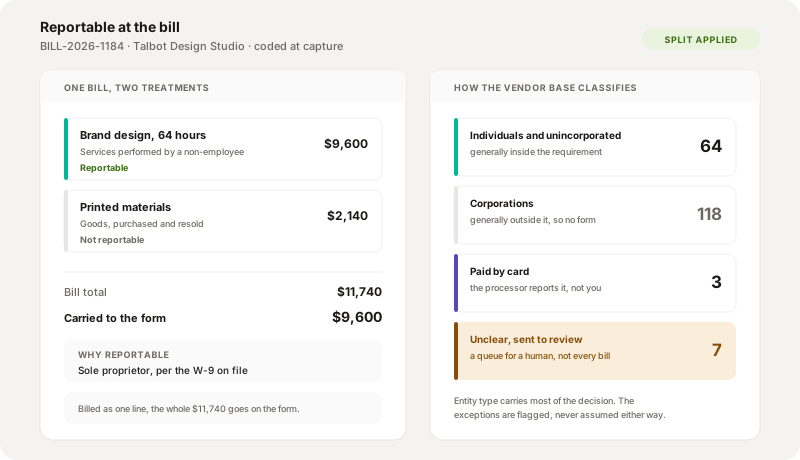
| Services and goods split | A bill mixing both | The service element identified, since goods are generally not reportable |
| Exception queue | Payees whose classification is unclear | A short list for a human, rather than a decision made silently |
| Form preparation | The year's reportable payments per payee | A 1099-NEC per payee, with the totals traceable to the payments behind them |
| Recipient delivery | Prepared forms | Delivered to the payee against the record, with delivery evidenced |
| Corrections | An error found after filing | A corrected return tracked against the original, both retained |
-
Classify at onboarding
- Input
- Entity type from the W-9
- Output
- Reportable or not, set on the payee before the first payment
-
Code at the bill
- Input
- Bill lines and expense category
- Output
- The reportable position carried on the payment, with its reason
-
Services and goods split
- Input
- A bill mixing both
- Output
- The service element identified, since goods are generally not reportable
-
Exception queue
- Input
- Payees whose classification is unclear
- Output
- A short list for a human, rather than a decision made silently
-
Form preparation
- Input
- The year's reportable payments per payee
- Output
- A 1099-NEC per payee, with the totals traceable to the payments behind them
-
Recipient delivery
- Input
- Prepared forms
- Output
- Delivered to the payee against the record, with delivery evidenced
-
Corrections
- Input
- An error found after filing
- Output
- A corrected return tracked against the original, both retained
1099-NEC FAQ
What buyers ask.
How do you decide whether a vendor is reportable?
Mostly from the entity type they certified on their W-9, which carries the majority of the decision, combined with what you bought. Corporations are generally outside the reporting requirement and individuals and unincorporated businesses are generally inside it, with categories that behave unusually flagged rather than assumed either way.
A vendor billed us for parts and labour on one invoice. What happens?
The service element is identified separately, because goods are generally not reportable and services generally are. Treating the whole invoice as one figure overstates or understates the form, and it is the kind of difference a payee notices and queries.
We paid a contractor by credit card. Is that on the form?
Generally not from you. Payments made by card or through certain third-party networks are reported by the processor instead, and including them means the payee receives two forms for the same money. Card payments are separated automatically for that reason.
What if we never got a W-9?
Then two things follow, and neither is that you skip the form. The payee still needs reporting, and the missing taxpayer number is what triggers backup withholding on the payments you make. The system flags this on the payee rather than at year end, when it is a filing problem instead of a solvable one.
Can we still file if a payee will not respond?
Yes, and you should. There is a documented process for filing when a payee has not supplied a taxpayer number, and it is better than not filing. What that process requires is evidence of having asked, which is the thing an unstructured email chase never produces.
See which of last year's payments were reportable.
Connect your books, free. Payments are classified against the payee records you hold, and the unclear ones come back as a short queue.