


Information Reporting | Foreign Payees
Not a 1099. A different regime entirely.
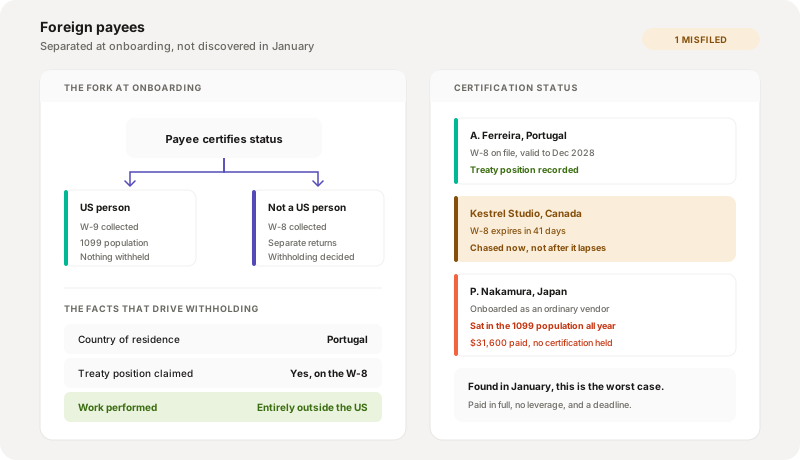
A payee who is not a US person does not belong in your 1099 population at all. They belong in a separate one with a different form, a W-8 instead of a W-9, a withholding question that turns on the treaty position, and a liability that sits with you if you get it wrong. Separated at onboarding, not discovered in January.
What the system does
Capability, input, output.
| Capability | Input | Output |
|---|---|---|
| Status at onboarding | The payee certifying their status | US or foreign, set before the first payment, driving which form is collected |
| W-8 on the record | The certification the payee provides | Held against the vendor with its expiry, since these do not last indefinitely |
| Treaty position | Country of residence and the claim made | Recorded against the payee, so withholding is a decision not an omission |
| Source of income | Where the work was performed | Flagged for a decision, because this drives whether US rules apply at all |
| Withholding at payment | A payment to a foreign payee | Computed and separated at the payment run rather than reconciled later |
| Separate population | The year's foreign payees | Reported on their own returns, never merged into the 1099 population |
| Expiry chase | A certification approaching expiry | Chased before it lapses, since a lapsed form changes the withholding position |
-
Status at onboarding
- Input
- The payee certifying their status
- Output
- US or foreign, set before the first payment, driving which form is collected
-
W-8 on the record
- Input
- The certification the payee provides
- Output
- Held against the vendor with its expiry, since these do not last indefinitely
-
Treaty position
- Input
- Country of residence and the claim made
- Output
- Recorded against the payee, so withholding is a decision not an omission
-
Source of income
- Input
- Where the work was performed
- Output
- Flagged for a decision, because this drives whether US rules apply at all
-
Withholding at payment
- Input
- A payment to a foreign payee
- Output
- Computed and separated at the payment run rather than reconciled later
-
Separate population
- Input
- The year's foreign payees
- Output
- Reported on their own returns, never merged into the 1099 population
-
Expiry chase
- Input
- A certification approaching expiry
- Output
- Chased before it lapses, since a lapsed form changes the withholding position
Foreign Payees FAQ
What buyers ask.
We hired a developer in another country. Do they get a 1099?
No. A payee who is not a US person is outside the 1099 regime and inside a different one, with its own form and its own withholding question. Issuing a 1099 to a foreign contractor is a common mistake and it is not a harmless one: it puts income into a reporting stream that does not apply to them.
Do we have to withhold on foreign contractors?
It depends on where the work was performed and on the treaty position, and it is genuinely a question rather than a default either way. Work performed entirely outside the US is often treated differently from work performed inside it. The system records the facts that drive the answer and surfaces the decision; your tax advisor should make it.
Our contractor says they have no US tax obligation. Is that enough?
Not on its own. What they are describing is usually a treaty position or a claim that the work was performed outside the US, and both may well be right. What matters is that the claim is certified on the correct form and held on the record, because if the position is later questioned it is your file that has to support it, not their recollection.
Our certifications are years old. Does that matter?
Yes. These forms do not last indefinitely, and a lapsed certification can change the withholding position on payments you are making now. Expiry is tracked and chased ahead of the date, in the same way exemption certificates are on the sales tax side, and for the same reason.
What is the actual failure mode you see?
A foreign contractor onboarded as an ordinary vendor, paid all year, and found during the January filing preparation. At that point you are asking someone who has already been paid in full for a tax certification, with no leverage and a deadline. Everything on this page exists to move that moment eleven months earlier.
See which of your vendors are not US persons.
Connect your books, free. Payees are split by the status on file, and the ones with no certification at all come back as a list.