


Information Reporting | State Filing
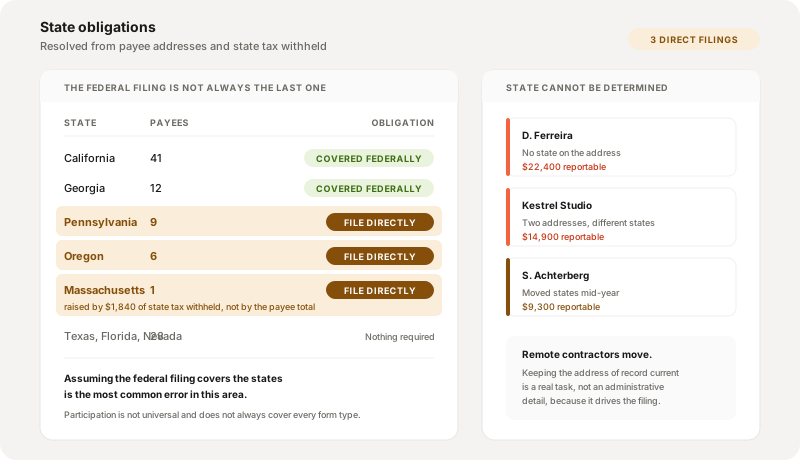
The federal filing is not always the last one.
Some states receive their copy automatically through the combined federal and state program. Some require a direct filing you have to make yourself. Some require nothing. A few want a filing in circumstances where no federal one was due at all. The obligation is worked out per state from where your payees actually are.
What the system does
Capability, input, output.
| Capability | Input | Output |
|---|---|---|
| Obligation by state | Payee addresses and your withholding | Which states need a filing, which are covered, and which need nothing |
| Combined program | States participating for your form types | Marked as covered by the federal submission, rather than filed twice |
| Direct filings | States that require their own | Prepared separately in that state's expected form and tracked to completion |
| Withholding-driven filings | State tax withheld from a payee | The filing raised, since withholding often creates one regardless of totals |
| Address quality | Payee addresses of record | Incomplete or ambiguous state data flagged before it drives an obligation |
| Per-entity view | Several filing entities | State obligations resolved per entity, since each files under its own number |
-
Obligation by state
- Input
- Payee addresses and your withholding
- Output
- Which states need a filing, which are covered, and which need nothing
-
Combined program
- Input
- States participating for your form types
- Output
- Marked as covered by the federal submission, rather than filed twice
-
Direct filings
- Input
- States that require their own
- Output
- Prepared separately in that state's expected form and tracked to completion
-
Withholding-driven filings
- Input
- State tax withheld from a payee
- Output
- The filing raised, since withholding often creates one regardless of totals
-
Address quality
- Input
- Payee addresses of record
- Output
- Incomplete or ambiguous state data flagged before it drives an obligation
-
Per-entity view
- Input
- Several filing entities
- Output
- State obligations resolved per entity, since each files under its own number
State Filing FAQ
What buyers ask.
Does the federal filing cover the states?
For some of them, through the combined federal and state program, and this is the assumption that produces missed filings. Participation is not universal, it does not always cover every form type, and a few states expect a direct filing regardless. Treating the federal submission as universally sufficient is the single most common error here.
How do you know which states are involved?
From where your payees are, which comes off the address of record, and from any state tax you withheld. Both matter, because withholding frequently creates a state obligation on its own even where the payee totals would not have.
Do you maintain the list of which states require what?
The per-state rules are configured and are yours or your advisor's to keep current, for the same reason we do not print thresholds anywhere on this site: states change participation and requirements independently, and a list we published once would rot quietly. What the system owns is applying whatever rules you set to your actual payee population.
Our contractors are all remote and move around. Is that a problem?
It is the case that makes this messy, and it is increasingly normal. The address of record is what drives the obligation, so keeping it current is a real task rather than an administrative detail. Payees with incomplete or ambiguous state data are flagged before they drive an obligation, not after.
What if we withheld state tax from a contractor?
That generally creates a filing obligation in that state, sometimes independent of the payee totals, so the filing is raised rather than inferred from the federal population. Withholding without the matching state filing is a mismatch the state can see from its own side.
See which states your payees create an obligation in.
Connect your books, free. Payee addresses and withholding are resolved into a per-state obligation list, with the covered ones marked.