


Entity Compliance | Calendar
Annual obligations are the ones that get missed.
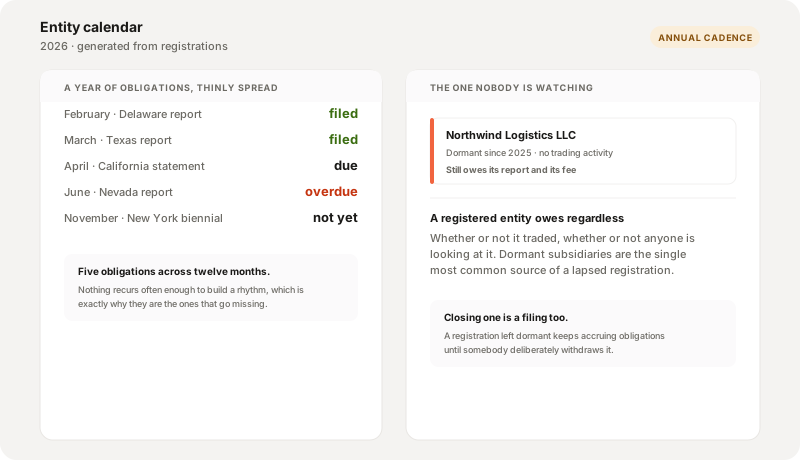
Something due every month gets a rhythm. Something due once a year, in a state you rarely think about, gets forgotten, and the escalation runs from late fee to loss of good standing to administrative dissolution. Obligations come from your registrations and qualifications with an owner against each, so nothing depends on whoever filed it last time remembering.
What the system does
Capability, input, output.
| Capability | Input | Output |
|---|---|---|
| Obligations from records | Registrations and qualifications per entity | The obligation set generated rather than typed and maintained |
| Annual and biennial cadence | What each state requires | Raised on that state’s cycle rather than an assumed annual one |
| Owner and status | Each obligation | A named person and a state of drafted, filed or overdue |
| Dependent data | Officers, addresses, agent | Flagged where a filing needs information that has changed |
| Escalation view | An overdue obligation | What the consequence is at this point, since it worsens in stages |
| Cross-obligation view | Entity, sales tax, payroll and income tax | One calendar rather than four, so a week’s workload is visible at once |
-
Obligations from records
- Input
- Registrations and qualifications per entity
- Output
- The obligation set generated rather than typed and maintained
-
Annual and biennial cadence
- Input
- What each state requires
- Output
- Raised on that state’s cycle rather than an assumed annual one
-
Owner and status
- Input
- Each obligation
- Output
- A named person and a state of drafted, filed or overdue
-
Dependent data
- Input
- Officers, addresses, agent
- Output
- Flagged where a filing needs information that has changed
-
Escalation view
- Input
- An overdue obligation
- Output
- What the consequence is at this point, since it worsens in stages
-
Cross-obligation view
- Input
- Entity, sales tax, payroll and income tax
- Output
- One calendar rather than four, so a week’s workload is visible at once
Compliance Calendar FAQ
What buyers ask.
Why does this need its own calendar?
It does not, and that is the point: it belongs on the same one as everything else. What it needs is not to be a separate spreadsheet owned by one person, which is what usually happens because entity filings are annual and nobody builds a rhythm around them.
Do you know each state’s due dates?
They are configured against your registrations and are yours to keep current. We do not publish a due-date table in product copy, because states change them and a stale date is worse than none. What the system guarantees is that every registration produces an obligation with an owner.
What is the actual cost of missing one?
It escalates. A late fee, then loss of good standing, which blocks you from getting a certificate a lender or acquirer wants, then administrative dissolution, which can invalidate contracts and requires a reinstatement to undo. The first stage is trivial and the last is not.
Can it cover franchise taxes and fees too?
Yes, and they belong here rather than with income tax, because they are a cost of being registered rather than a tax on profit. Several states charge them regardless of activity, which surprises teams who assume a dormant entity costs nothing.
We have a dormant subsidiary. Does it still owe anything?
Almost certainly. A registered entity generally owes its annual report and any franchise fee whether or not it traded, and dormant subsidiaries are the single most common source of a lapsed registration, precisely because nobody is looking at them.
Put every entity obligation on one calendar.
Connect your entities, free. Obligations come from your registrations, each with an owner and a status you can see.