


Entity Compliance | Annual Reports
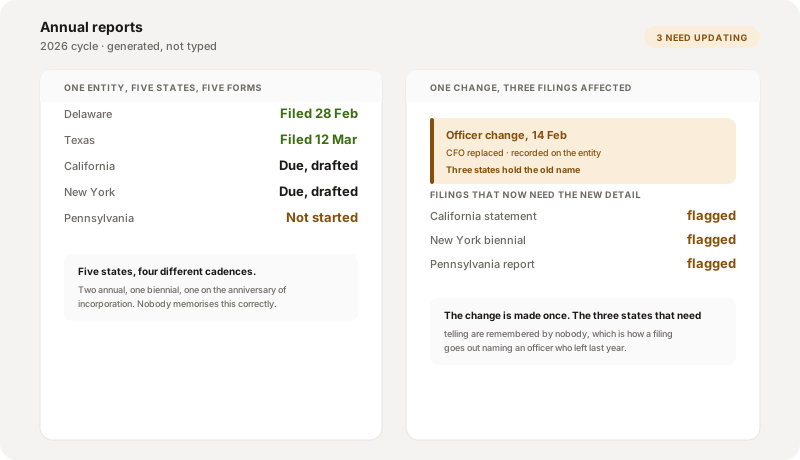
One entity, five states, five different reports.
Every state you are registered in wants its own report on its own cadence, and each one asks for officers, addresses and a registered agent that have to be current. Obligations are generated from your registrations rather than typed into a spreadsheet, and the details each filing depends on live on the entity rather than in someone’s memory.
What the system does
Capability, input, output.
| Capability | Input | Output |
|---|---|---|
| Obligations from registrations | States the entity is registered in | The report set generated, rather than maintained by hand |
| Filing data | Officers, addresses, registered agent on the entity | Pre-filled from the record the rest of the business already updates |
| Owner and status | Each obligation | A named owner and a state of drafted, filed or overdue |
| Change detection | An officer or address change | The filings that now need updating, flagged rather than discovered at renewal |
| Good standing | Filed confirmations | The standing position per state, which is what a lender or acquirer asks for |
| Evidence | A completed filing | Confirmation and reference held against the entity and the period |
-
Obligations from registrations
- Input
- States the entity is registered in
- Output
- The report set generated, rather than maintained by hand
-
Filing data
- Input
- Officers, addresses, registered agent on the entity
- Output
- Pre-filled from the record the rest of the business already updates
-
Owner and status
- Input
- Each obligation
- Output
- A named owner and a state of drafted, filed or overdue
-
Change detection
- Input
- An officer or address change
- Output
- The filings that now need updating, flagged rather than discovered at renewal
-
Good standing
- Input
- Filed confirmations
- Output
- The standing position per state, which is what a lender or acquirer asks for
-
Evidence
- Input
- A completed filing
- Output
- Confirmation and reference held against the entity and the period
Annual Reports FAQ
What buyers ask.
What happens if we miss one?
Depends on the state and it escalates: late fees first, then loss of good standing, then administrative dissolution. The last one is the expensive one, because it can invalidate contracts and takes a reinstatement filing to undo. None of it is hard to avoid, which is why missing it is usually a tracking failure rather than a decision.
Do you file them for us?
We generate the obligation, hold the data each filing needs and track it to completion. Submission routes vary by state and many teams use their registered agent or counsel for that step, so we do not require you to change it. The confirmation records back against the entity either way.
Our officers changed last quarter. What now?
The filings that depend on that information are flagged. This is the common failure: the change is made in one place, and the three states that need telling are remembered by nobody. Holding officers and addresses on the entity means the affected filings surface themselves.
We are registered in states we no longer sell into. Does that matter?
Yes, and it is a live cost. A registration you have stopped using still owes its annual report and still accrues penalties. Withdrawing properly is a filing of its own, and until it is done the obligation continues.
Can our registered agent see this?
Yes, scoped to the entities they act for. Most agents will file on your behalf if given current information, and the reason they often cannot is that nobody sends it to them in time.
More in Entity Compliance
Related features
See every annual report your entities owe.
Connect your entities, free. Obligations come from your registrations, each with an owner and the data the filing needs.