


Entity Compliance | Registered Agent
The address lawsuits are sent to.
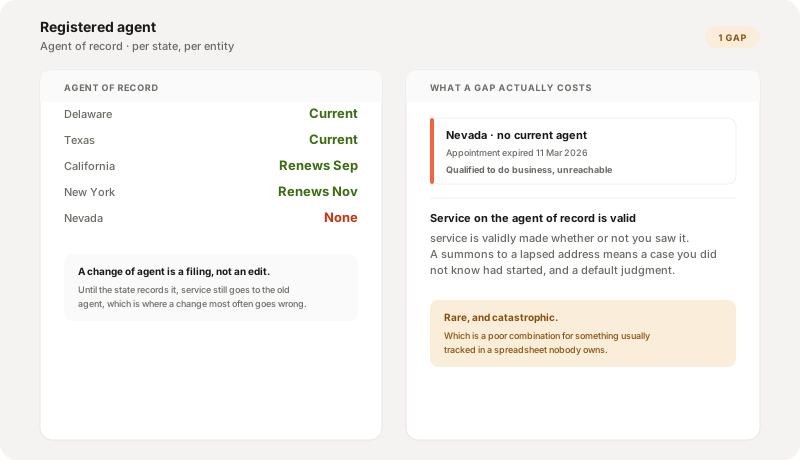
Every state you are qualified in requires a designated agent to receive service of process and official notices. It sounds like administrative trivia until an agent lapses, a summons is served on an address nobody monitors, and a default judgment arrives. The appointment, the address and the renewal are held per state and per entity.
What the system does
Capability, input, output.
| Capability | Input | Output |
|---|---|---|
| Agent of record | Appointment per state | Who the agent is, from which date, with the appointment document |
| Renewal tracking | Agent service periods | Renewal surfaced before the appointment lapses |
| Change of agent | A new appointment | The state filing it requires, tracked to confirmation |
| Address of record | The agent address on file | Checked against what the state actually holds, since the two drift |
| Notice handling | Documents received by the agent | Routed to a named owner rather than to a general inbox |
| Coverage gaps | States you are qualified in | Any without a current agent, which is the state you cannot afford to have |
-
Agent of record
- Input
- Appointment per state
- Output
- Who the agent is, from which date, with the appointment document
-
Renewal tracking
- Input
- Agent service periods
- Output
- Renewal surfaced before the appointment lapses
-
Change of agent
- Input
- A new appointment
- Output
- The state filing it requires, tracked to confirmation
-
Address of record
- Input
- The agent address on file
- Output
- Checked against what the state actually holds, since the two drift
-
Notice handling
- Input
- Documents received by the agent
- Output
- Routed to a named owner rather than to a general inbox
-
Coverage gaps
- Input
- States you are qualified in
- Output
- Any without a current agent, which is the state you cannot afford to have
Registered Agent FAQ
What buyers ask.
What actually goes wrong here?
A default judgment. Service is validly made on the agent of record, the agent is lapsed or the address is stale, nobody sees the summons, and the case is lost without anyone knowing it started. It is rare and it is catastrophic, which is a bad combination for something tracked in a spreadsheet.
Can we be our own agent?
In the state where you have an office, often yes, and plenty of companies are. The constraint is that the agent needs an address in that state that is staffed during business hours, which is why commercial agents exist for every other state you qualify in.
We changed agents last year. Is that just an internal update?
No, it is a filing with each state, and it is not effective until the state records it. Until then service goes to the old agent. Treating an agent change as an internal record update is one of the more common ways a gap opens.
Do you act as our registered agent?
No, and we would not. That is a service with a physical presence requirement in every state, provided well by firms that do only that. What we do is hold who yours is, per state, and make a lapse visible before it becomes a default judgment.
How does this connect to our other filings?
The agent and the address feed the annual reports, so a change in one is a change the others need. Holding them on the entity means the affected filings flag themselves rather than being remembered separately.
More in Entity Compliance
Related features
Check you have a current agent in every state.
Connect your entities, free. Agents, appointments and renewals resolve per state, and any gap comes back as a list.