


Entity Compliance | Foreign Qualification
Incorporated in one state. Operating in seven.
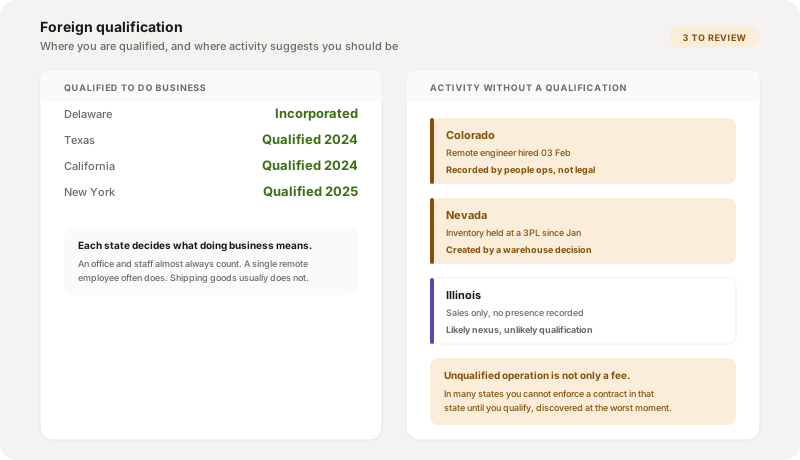
Doing business in a state you are not incorporated in generally requires qualifying there, and each state decides for itself what doing business means. An office and employees usually count. Remote staff, inventory and sustained contracting often do. Qualifications are held per entity per state, alongside the activity that suggests one may be needed.
What the system does
Capability, input, output.
| Capability | Input | Output |
|---|---|---|
| Qualification record | States the entity is qualified in | Effective date, file number and standing, held on the entity |
| Activity signals | Employees, offices, inventory locations you record | States where activity suggests qualification is worth reviewing |
| Downstream obligations | A new qualification | The annual report, agent and fees it brings with it, generated |
| Withdrawal | Ceasing activity in a state | The withdrawal filing raised, so the obligation actually stops |
| Standing per state | Filed reports and fees | Good standing or not, which is what a lender or acquirer checks |
| Entity coverage | Several entities | Assessed per entity, since qualification follows the legal entity |
-
Qualification record
- Input
- States the entity is qualified in
- Output
- Effective date, file number and standing, held on the entity
-
Activity signals
- Input
- Employees, offices, inventory locations you record
- Output
- States where activity suggests qualification is worth reviewing
-
Downstream obligations
- Input
- A new qualification
- Output
- The annual report, agent and fees it brings with it, generated
-
Withdrawal
- Input
- Ceasing activity in a state
- Output
- The withdrawal filing raised, so the obligation actually stops
-
Standing per state
- Input
- Filed reports and fees
- Output
- Good standing or not, which is what a lender or acquirer checks
-
Entity coverage
- Input
- Several entities
- Output
- Assessed per entity, since qualification follows the legal entity
Foreign Qualification FAQ
What buyers ask.
What counts as doing business?
Each state decides, and the definitions are not identical. An office and employees almost always count. A single remote employee often does. Inventory held in a state, or sustained contracting there, frequently does. Simply shipping goods to customers usually does not on its own. It is a legal judgement rather than a threshold, which is why the system surfaces the signals rather than asserting the answer.
How is this different from sales tax nexus?
Different obligation, different trigger, frequently confused. Sales tax nexus is about collecting tax on sales. Qualification is about the right to conduct business in the state at all. You can have one without the other, and the penalties differ: unqualified operation can mean you cannot bring a lawsuit in that state until you fix it.
We have been operating unqualified for two years. How bad is it?
Fixable, usually with back fees and penalties, and worth taking to counsel rather than a form. The sharper risk is not the fee: in many states an unqualified company cannot enforce its contracts in that state’s courts until it qualifies, which tends to be discovered at the worst possible moment.
Do you file the qualification?
No. That is a filing you or your counsel make with the state. What we hold is the result and everything it triggers, so a new qualification immediately produces its annual report obligation and its agent requirement rather than being remembered separately.
We hired a remote employee in a new state. Does that qualify us?
Often, and it is the most common way companies become unqualified without noticing, because hiring runs through people operations rather than legal. Recorded work locations surface as a signal so the question at least gets asked.
See where your activity suggests you should be qualified.
Connect your entities, free. Qualifications, activity signals and the obligations each one brings resolve per state.