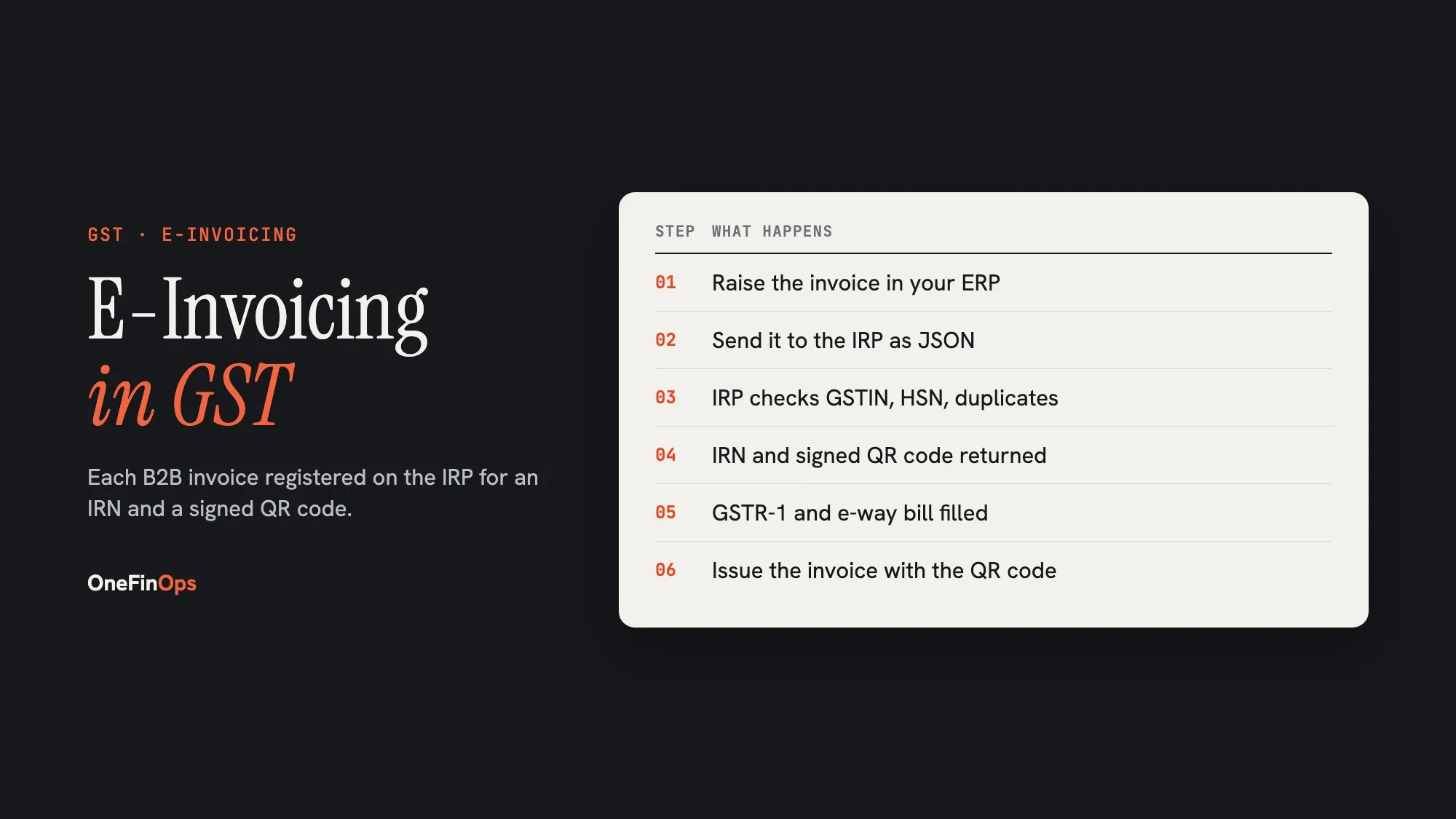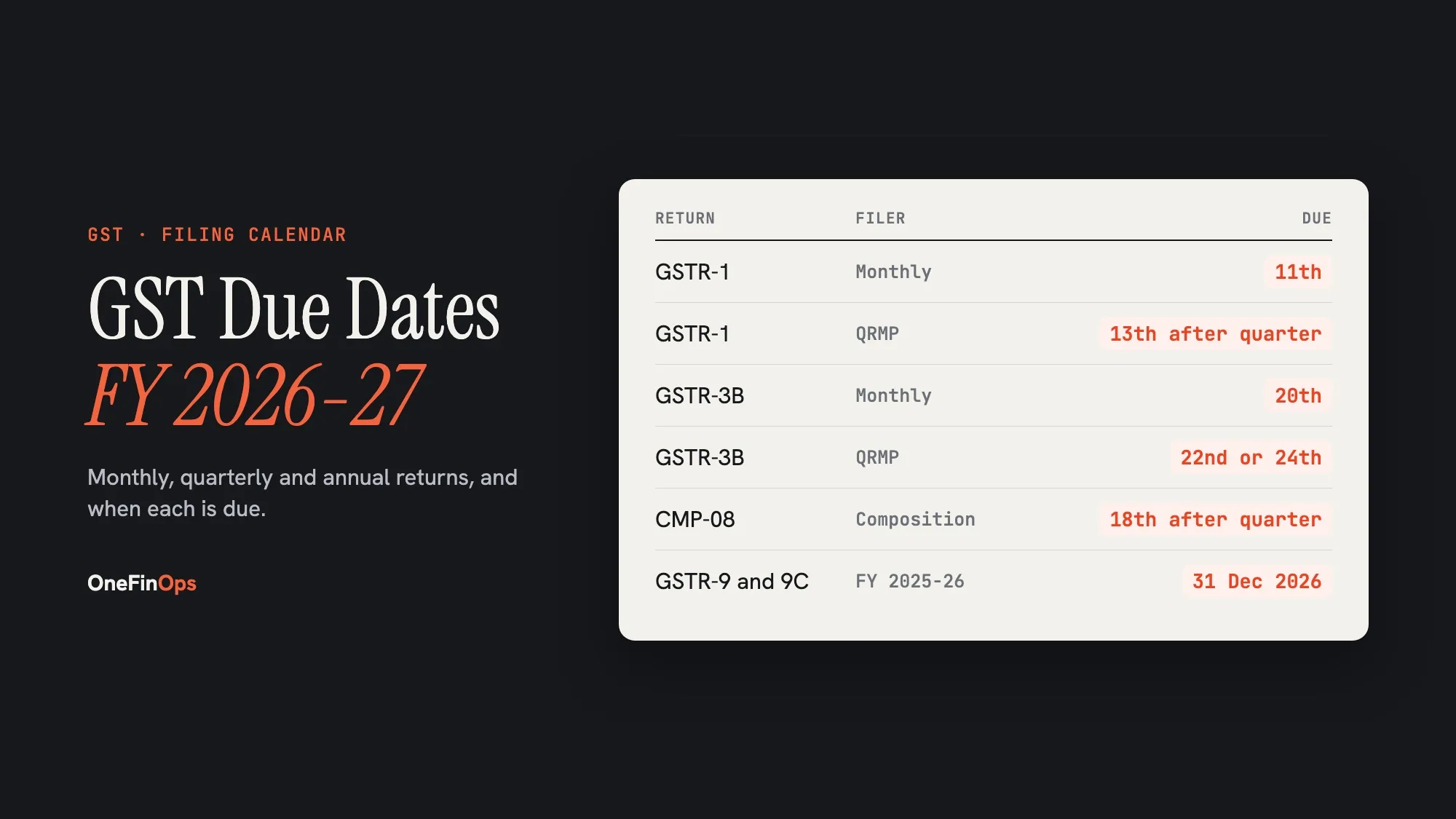

E-invoice applicability under GST depends on aggregate turnover: every registered business whose PAN-level aggregate turnover exceeded ₹5 crore in any financial year from 2017-18 onwards must report B2B invoices and notes to an Invoice Registration Portal (IRP) and get an IRN. Under rule 48(5), an invoice without a required IRN is not an invoice, so your buyer loses the credit.
In OneFinOps, the Tax Agent raises the IRN as the invoice is issued and stores the response on it.
Key takeaways
- The limit is ₹5 crore aggregate turnover, from 1 August 2023.
- Cross it in any year since 2017-18 and you stay in.
- At ₹10 crore AATO or more, the IRP rejects documents older than 30 days.
What is the e-invoice limit in GST?
The e-invoice limit is ₹5 crore of aggregate turnover, under Notification 10/2023-Central Tax from 1 August 2023, lowered in stages from ₹500 crore in October 2020. As of September 2026 no notification lowers it further.
It covers B2B invoices, credit and debit notes, exports, SEZ supplies and deemed exports, for services as much as goods. B2C invoices, bills of supply, delivery challans and imports are out. Some classes are exempt whatever their turnover, under Notification 13/2020-Central Tax as amended: insurers, banking companies, financial institutions including NBFCs, goods transport agencies, passenger transport services, multiplex cinema admissions, SEZ units (not developers), government departments and local authorities. For how an IRN is generated, see what is e-invoicing in GST.
How is aggregate turnover calculated for e-invoicing?
Aggregate turnover under section 2(6) of the CGST Act is counted across all GSTINs under one PAN. It includes taxable, exempt, nil-rated, export and inter-state supplies, and excludes GST itself and inward reverse charge supplies.
Example. Shreeji Engineering Pvt Ltd has GSTINs in Gujarat and Maharashtra.
| Financial year | Gujarat | Maharashtra | Aggregate |
|---|---|---|---|
| 2023-24 | ₹3,45,00,000 | ₹1,80,00,000 | ₹5,25,00,000 |
| 2025-26 | ₹3,05,00,000 | ₹1,70,00,000 | ₹4,75,00,000 |
Neither GSTIN crossed ₹5 crore alone, but the aggregate did in FY 2023-24. So e-invoicing applied to both from 1 April 2024, and still applies in FY 2026-27. A B2B invoice without an IRN would expose Shreeji to a penalty under section 122 of ₹10,000 or the tax involved, whichever is higher.
What is the 30-day time limit for e-invoice?
From 1 April 2025, taxpayers with aggregate annual turnover (AATO) of ₹10 crore or more cannot report a document to the IRP more than 30 days after its date; for ₹100 crore and above it has applied since 1 November 2023. An invoice dated 1 April 2026 must be reported by 30 April 2026. Below ₹10 crore the IRP will not block you, but a late IRN is still a late invoice.
How OneFinOps handles e-invoicing
The Tax Agent determines rate, place of supply and reverse charge as the invoice is raised, then raises the IRN through its GSP connection to the IRP and stores the reference number and signed response on the invoice. A failure goes to a queue with its reason, a retry and an owner, so the gap is visible rather than silent.
That is the difference from uploading JSON files by hand or passing invoices to a separate tool: the IRN lives on the same invoice that feeds GSTR-1 and the ledger.
See GST e-invoicing in OneFinOps