E-invoicing in GST means a registered business reporting each B2B invoice, credit note and debit note to a government Invoice Registration Portal (IRP), which validates it and returns a unique Invoice Reference Number (IRN) and a signed QR code. When that step sits outside billing, invoices leave without a QR code, and errors found after 24 hours cannot be cancelled.
OneFinOps treats the IRN as part of raising the invoice, not a separate upload someone has to remember.
Key takeaways
- You create invoices in your own software and register them on an IRP.
- An IRN can be cancelled only within 24 hours, and only in full.
- E-invoice data fills your GSTR-1 and can generate the e-way bill.
What is IRN in GST?
IRN stands for Invoice Reference Number. It is a unique 64-character hash the IRP generates from four fields: supplier GSTIN, document number, document type (invoice, credit note or debit note) and financial year. Upload the same invoice number twice in a year and the second is rejected. The signed QR code carries the GSTINs, invoice number, date and value, the main HSN code and the IRN, and it must appear on the invoice.
How does e-invoicing work?
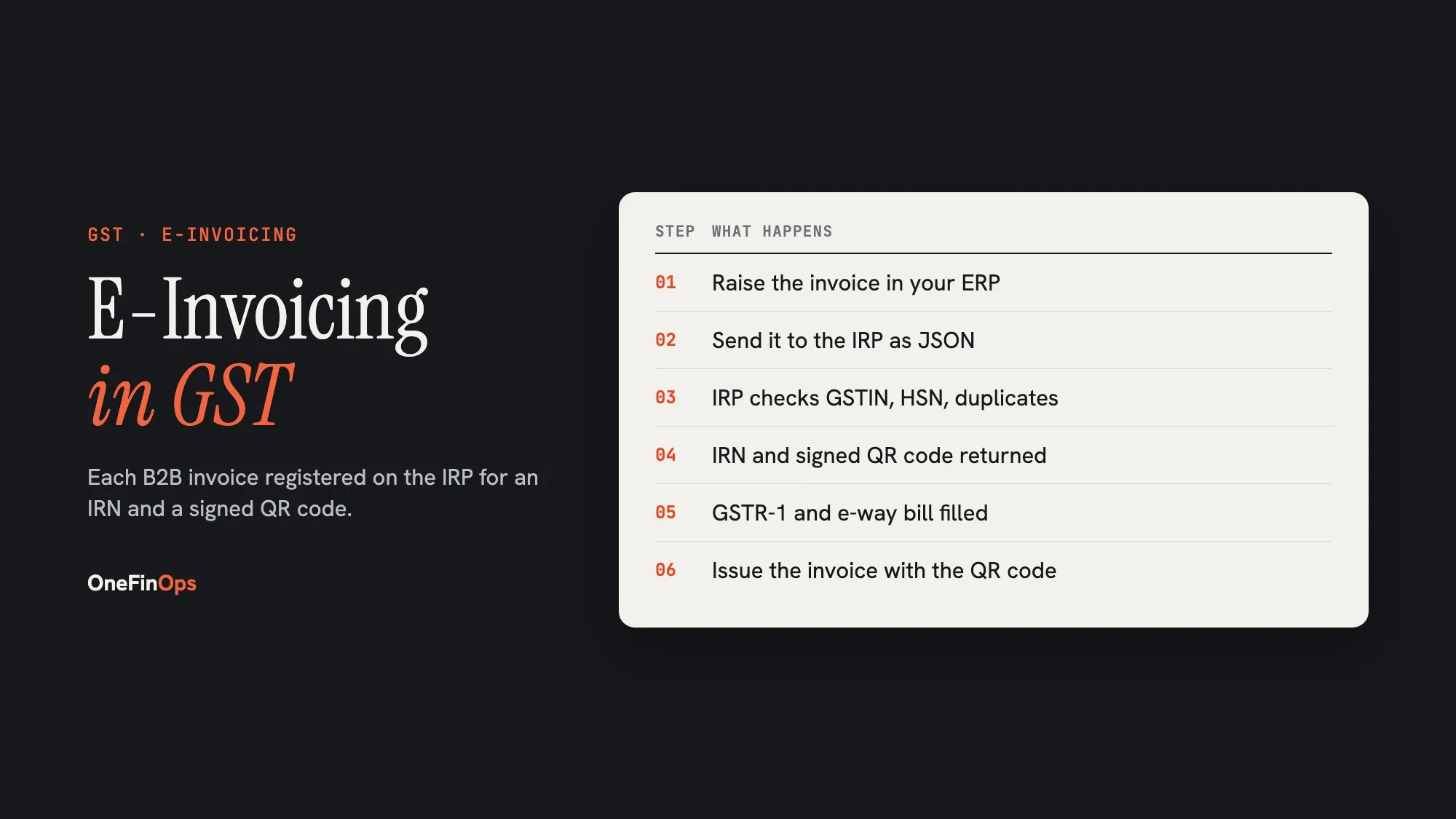
- Prepare the invoice in your ERP or billing software with every FORM GST INV-01 field.
- Send it to an IRP as JSON, through an API or a GST Suvidha Provider.
- The IRP validates it: schema, GSTINs, HSN, duplicates and, for turnover of ₹10 crore or more, the 30-day limit.
- The IRP returns a signed JSON with the IRN, acknowledgement number and date, and the signed QR code.
- Data is shared with the GST system, filling the supplier’s GSTR-1 and the buyer’s IMS. Part A of the e-way bill can be prepared too.
- Issue the invoice with the QR code printed on it.
E-invoicing applies where aggregate turnover exceeded ₹5 crore in any year since 2017-18. See e-invoice applicability.
Example. Shreeji Engineering, Ahmedabad, sells valves worth ₹5,00,000 to Rudra Foods, Pune, on 14 September 2026, with IGST of ₹90,000 at 18%. Its ERP gets the IRN and QR code back in seconds. When Rudra rejects 10 damaged valves, Shreeji issues an e-invoiced credit note for ₹19,000 plus ₹3,420 IGST, because partial cancellation is not allowed.
E-invoice cancellation and time limits
| Situation | What you can do |
|---|---|
| Within 24 hours of IRN generation | Cancel the IRN on the IRP, in full, with a reason code |
| An e-way bill on the IRN is active | Cancel the e-way bill first |
| After 24 hours | No IRP cancellation; issue a credit note or amend in GSTR-1 |
| Reusing a cancelled invoice number | Not allowed |
From 1 April 2025, businesses with aggregate annual turnover of ₹10 crore or more cannot report a document more than 30 days after its date. An invoice that should have been e-invoiced but was not is not treated as an invoice under rule 48(5), and the supplier faces a penalty under section 122 of ₹10,000 or the tax involved, whichever is higher.
How OneFinOps handles e-invoicing
The Tax Agent determines rate, place of supply and reverse charge as the document is raised, then raises the IRN from the invoice itself and stores the reference number and signed response on it. When the IRP rejects a document, it goes to a failure queue with the reason, a retry and an owner.
The usual alternative is a billing tool that records the invoice and a separate e-invoicing tool that registers it, with someone reconciling the two before GSTR-1. Here the invoice, its IRN, the e-way bill and the return are one record.
See GST e-invoicing in OneFinOps