
Topic
GST basics
The building blocks of GST: registration, HSN and SAC codes, place of supply and the schemes a business can choose.
Guides
Start with the full guide.
GST & Indirect Tax E-Invoicing in India: The Implementation Playbook A complete operational guide to e-invoicing under GST. Applicability thresholds, IRN generation, e-way bill linkage, IRP integration, error codes, B2C QR codes, and the workflow that makes invoicing seamless across multi-GSTIN, multi-system businesses. OneFinOps Editorial11 min GST & Indirect Tax Multi-GSTIN Consolidation: The Operational Guide for Pan-India Businesses A complete operational guide to running a single business across multiple GSTINs. Branch transfers, ISD distribution, cross-charging, consolidated returns, audit trail, and the architecture that keeps a 10-state operation closing on time. OneFinOps Editorial12 min
Articles
GST basics, explained.
 GST E-Invoice Applicability and Turnover Limit under GST E-invoicing applies to every GST-registered business whose PAN-level aggregate turnover crossed ₹5 crore in any year since 2017-18. OneFinOps Editorial 3 min
 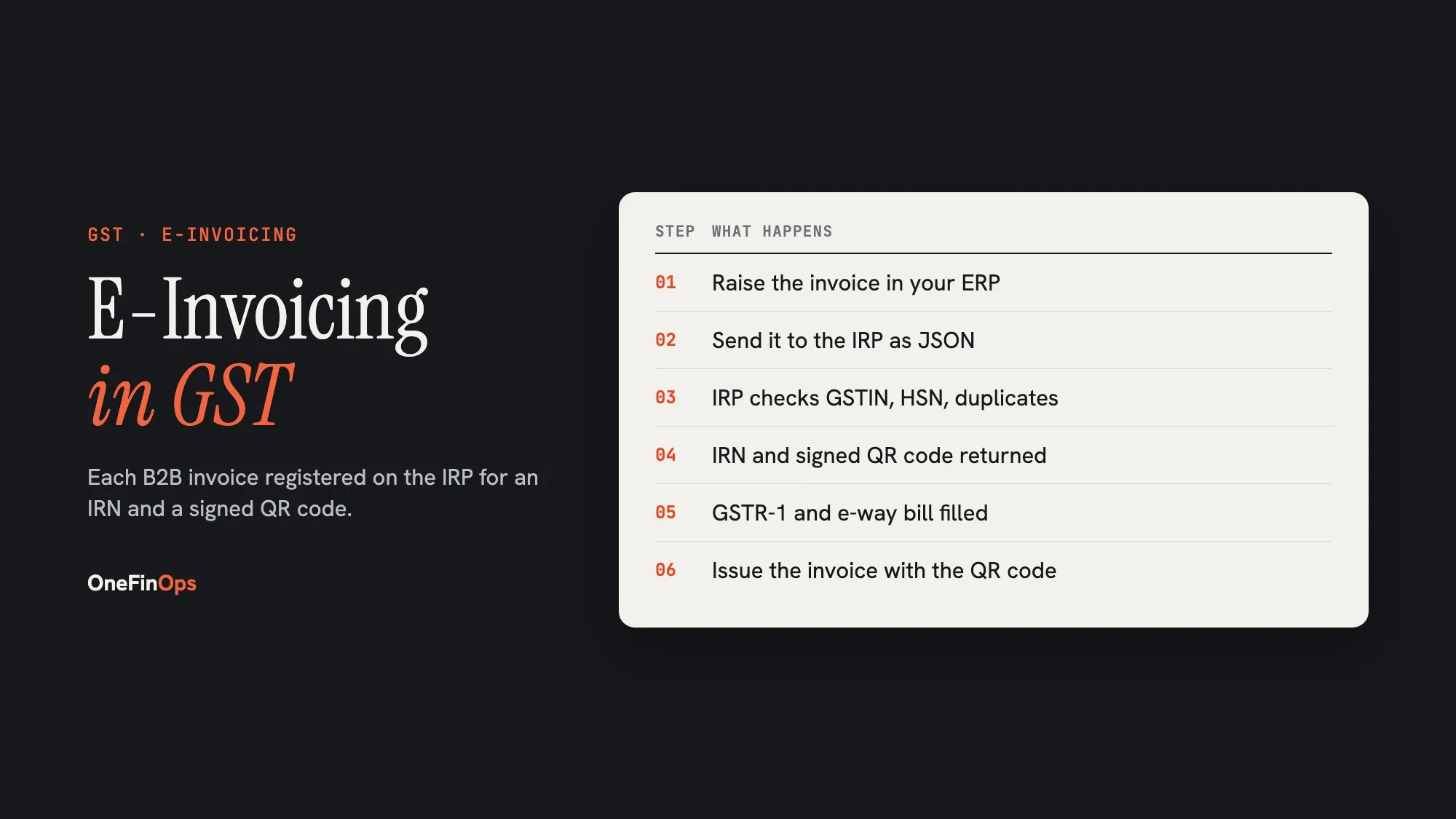 GST What is E-Invoicing in GST? IRN, Process and Rules E-invoicing in GST means reporting each B2B invoice to a government Invoice Registration Portal, which validates it and returns an IRN and a signed QR code. OneFinOps Editorial 3 min
  GST What is Input Tax Credit in GST? Conditions, Example and Rules Input tax credit is the GST paid on business purchases that you deduct from the GST you owe on sales, if the section 16 conditions are met. OneFinOps Editorial 3 min
 Glossary
The terms you will meet.
GST basics Anti-Profiteering Anti-profiteering under GST requires businesses to pass on the benefit of tax rate reductions or increased ITC to consumers through proportionate price reductions. Also called anti-profiteering provisions, section 171 of the CGST Act Trade and foreign exchange Central Excise A tax on the manufacture of goods within India, levied by the central government and largely subsumed by GST in 2017. Also called central excise duty GST basics Composition Scheme The Composition Scheme is a simplified GST compliance option for small taxpayers with turnover up to Rs. 1.5 crore, allowing them to pay tax at a fixed rate without maintaining detailed invoicing records. Also called GST composition scheme, composition levy, section 10 composition Accounts receivable Credit Note A credit note is a document issued by a seller to a buyer reducing the value of a previously issued invoice, typically due to returns, pricing corrections, or deficiency in services. Also called credit memo, credit memorandum Accounts payable Debit Note A debit note is a document issued by a buyer to a seller indicating a reduction in the amount payable, typically due to goods returned, pricing errors, or defective supplies. Also called debit memo, debit memorandum E-invoicing E-Way Bill A mandatory electronic document required for the movement of goods valued at more than Rs. 50,000 under India's GST regime. Also called eway bill, electronic way bill, EWB GST basics GST (Goods and Services Tax) India's unified indirect tax that replaced multiple central and state levies, creating a single national market for goods and services. Also called Goods & Services Tax GST basics GST Council The GST Council is India's constitutional body comprising Union and State finance ministers that makes recommendations on GST rates, rules, exemptions, and administrative procedures. Also called Goods and Services Tax Council GST basics GST Registration GST registration is the process by which a business obtains a unique GSTIN from the GST portal, making it a registered taxable person under India's Goods and Services Tax law. Also called GSTIN registration, GST enrolment, Form GST REG-01 GST basics HSN Code (Harmonized System of Nomenclature) An internationally standardized numerical code used to classify goods for taxation and trade purposes under India's GST system. Also called HSN, harmonised system code, HS code GST basics Place of Supply Place of Supply is the GST concept that determines the location where a supply is deemed to occur, which in turn decides whether IGST, CGST/SGST, or UTGST applies to the transaction. Also called place of supply rules, place of supply under GST Input tax credit Reverse Charge Mechanism (RCM) A GST provision where the recipient of goods or services is liable to pay the tax instead of the supplier. Also called reverse charge, reverse charge under GST GST basics SAC Code (Service Accounting Code) A classification system used under GST to categorize and identify different types of services for taxation purposes. Also called SAC, services accounting code
See it in the product
GST basics, in the product.
Tax & ComplianceGST ComplianceGSTR-2B reconciliation nightly. GSTR-1, 3B, 9, 9C drafted from your books. ITC eligibility tracked. Multi-state, multi-GSTIN, multi-country.Financial OperationsItem Master SoftwareOne item master across invoices, bills, POs and price lists. HSN/SAC auto-classified against the live CBIC master. Multi-currency price lists.GST CompliancePlace of Supply RulesEngine validates POS at invoice creation. Branch transfer vs interstate sale auto-classified.Item Master SoftwareHSN Code FinderSearch the live CBIC HSN master. Rate, ITC eligibility, notification refs in one click.Item Master SoftwareSAC Code FinderSearch the live CBIC SAC master for service codes. Rate and exemption refs surfaced.GST E-Invoicing SoftwareMulti-GSTIN ManagementPer-GSTIN settings, eligibility, sign-off. State-wise EWB thresholds.DomainFinancial ManagementAccounting, Accounts Payable, Accounts Receivable, Banking and Cash, Tax and Compliance, Financial Reporting