Skip to content

Budgeting & Forecasting

Budgeting and forecastingon the ledger that runs the business.

Build the annual operating plan, run department budgets, roll forecasts forward and project 13-week cash. Budget versus actual is live, because the actuals are the same ledger that ran the period.

OneFinOps Budgeting and Forecasting

Trusted by finance teams

  • PathoGenie
  • Sharada Agro Industries
  • SRF Capital
  • Absolute Labs
  • CultSet
  • Lead with Tribe
  • GehnaERP
  • Beacon
  • Praval
  • EverUptime

Budget Management

Build a budget once. Track it all year.

Top-down targets meet bottom-up department input on one grid. Spread by month, copy last year, or grow a line by a percentage. Lock a version, and every actual lands against it the moment a journal posts.

Budget Management screenshot

Annual Operating Plan

Run the AOP cycle without the spreadsheet sprawl.

Open a planning cycle, hand each owner their slice, collect submissions, and route them through review and sign-off. Versions are kept, not overwritten. The approved plan becomes the budget of record.

Annual Operating Plan screenshot

Budget vs Actual

Variance the day it happens, not in the month-end pack.

Budget, actual and variance side by side, by account and by dimension. Drill from a red cell to the journal entry, and from there to the source bill or invoice. No CSV export, no manual tie-out.

Budget vs Actual screenshot

Rolling Forecasts

Re-forecast on a cadence, not once a year.

Replace elapsed months with actuals and keep the horizon rolling forward. Compare the live forecast to the original plan and the prior forecast on the same view. The number always reflects where the business actually is.

Rolling Forecasts screenshot

Scenario Planning

Base, best and worst, side by side.

Model a price change, a hiring freeze or a slip in collections, and see the P&L and cash impact of each scenario next to the plan. Promote any scenario to the working forecast when reality picks one.

Scenario Planning screenshot

Cash Flow Forecasting

A 13-week cash runway you can trust.

Receivables, payables, payroll and tax due dates roll into a direct cash forecast off the live ledger. Watch the runway move as invoices clear and bills are scheduled. The treasury view your board asks for.

Cash Flow Forecasting screenshot

Driver-Based Planning

Plan on drivers, not hard-coded numbers.

Tie revenue to units and price, headcount to fully-loaded cost, and cloud spend to usage. Change one driver and every dependent line recalculates. The model explains itself when someone asks how you got there.

Driver-Based Planning screenshot

Workforce Planning

Headcount and cost, planned together.

Plan roles by team, with start dates, fully-loaded cost and ramp. Personnel cost flows straight into the budget and the cash forecast. Approved hires reconcile against actual payroll as they join.

Workforce Planning screenshot

Revenue Planning

A revenue plan tied to the pipeline and the books.

Plan revenue by product, segment or region from the same chart of accounts your statements use. Subscription, usage and one-off lines model differently. The plan reconciles to booked revenue without a remap.

Revenue Planning screenshot

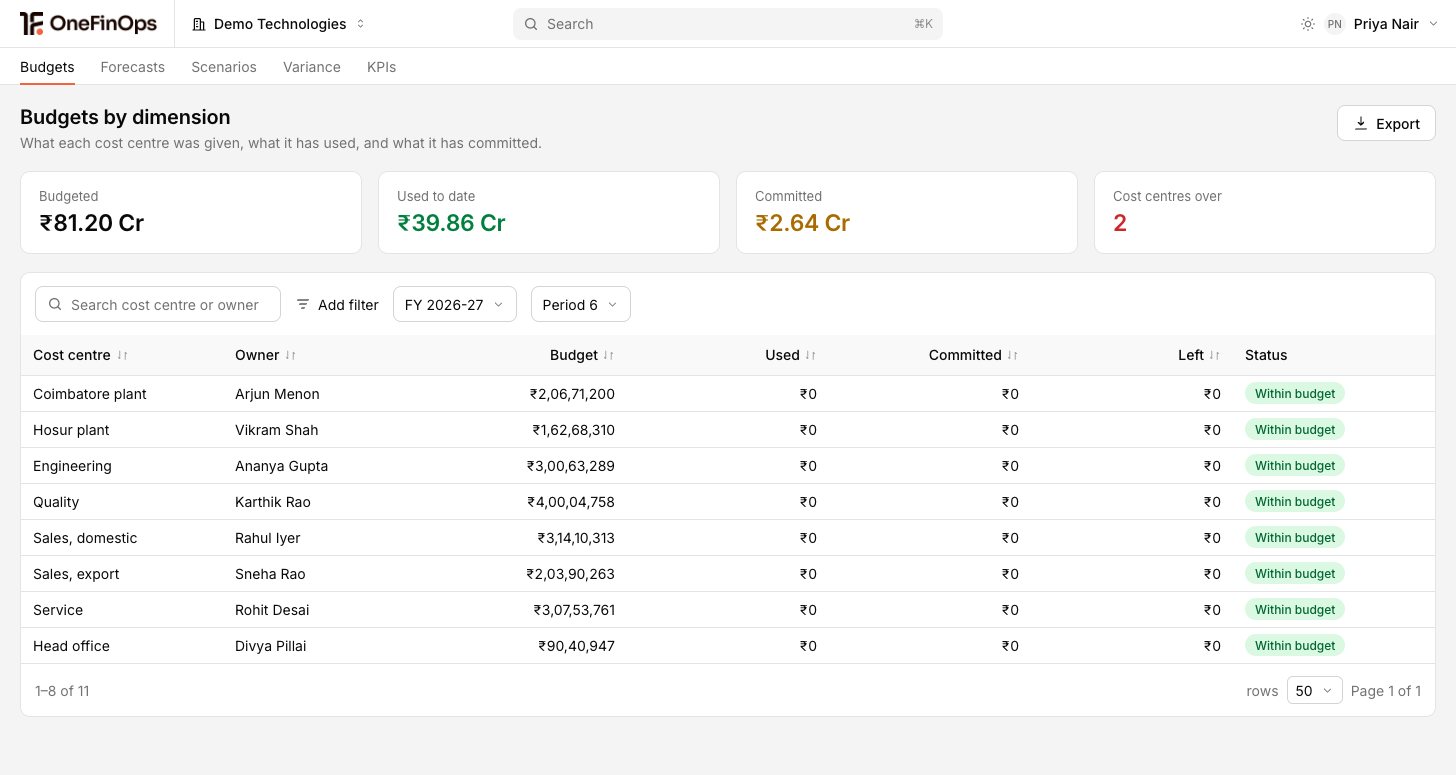
Departmental Budgets

Every cost centre owns its own number.

Give each department a budget, an owner and a view scoped to their lines. Roll the parts up to the company plan automatically. Spend requests check against the remaining budget before they are approved.

Departmental Budgets screenshot

Why teams plan here

What changes when the plan lives on the ledger.

1 grid

top-down targets and bottom-up input in one place

Live

budget vs actual, the moment a journal posts

13 weeks

direct cash runway off real due dates

0 exports

no CSV round-trip between the books and the plan

Customer stories

Finance teams planning on OneFinOps.

One plan of record, forecasts that re-cut on a cadence, and a cash runway the board can read.

Prasanthi Vijayagiri

Prasanthi Vijayagiri

Co-founder · EverUptime

As an early-stage team, we can't justify a finance back office. OneFinOps gives us clean, compliant books from day one.

Sashi Pagadala

Sashi Pagadala

CEO · Praval

Coordinating finance and procurement used to eat hours every day. OneFinOps now saves our team nearly 18 hours a week.

Rakesh Vaddadi

Rakesh Vaddadi

Co-founder & CEO · Beacon.li

OneFinOps centralized our accounting, GST and approvals into one workflow. We now process vendor invoices 2.4x faster.

Buyer FAQ

What teams ask before they plan here.

How is this different from budgeting in our accounting system?

Most accounting tools let you key a single annual budget and show a basic variance column. This is a planning surface: multiple versions, rolling forecasts, scenarios and driver-based models, with the actuals coming straight off the same ledger. You plan and report on one set of numbers, not two.

Can we keep working the way we do in spreadsheets?

The grid behaves like a spreadsheet: spread by month, copy a prior period, grow a line by a percentage, paste from Excel. The difference is that versions are kept, the actuals are connected, and there is no broken link or stale tab to chase.

Does budget vs actual update automatically?

Yes. Actuals are read from the operating ledger, so variance updates as journals post. There is no import step and no period-end reconciliation between a separate planning file and the books.

Can different departments own their own budgets?

Yes. Each cost centre gets an owner and a scoped view of its own lines. Submissions roll up to the company plan, and approvals route through whatever review chain you define.

Can we plan in multiple currencies and entities?

Yes. Plans inherit the entity and currency structure of your books. Each entity plans in its functional currency and rolls up to the group view at your chosen rate, the same way consolidation works on the ledger.

How does the 13-week cash forecast get its numbers?

It reads open receivables, scheduled payables, payroll and tax due dates from the live ledger and projects cash on a direct basis. As invoices clear and bills are scheduled, the runway moves with them.

See your next quarter forecast on your own ledger.

Connect your books, pick a few drivers, and the first forecast runs on your actuals, your departments and your cash due dates. Not a sandbox.