
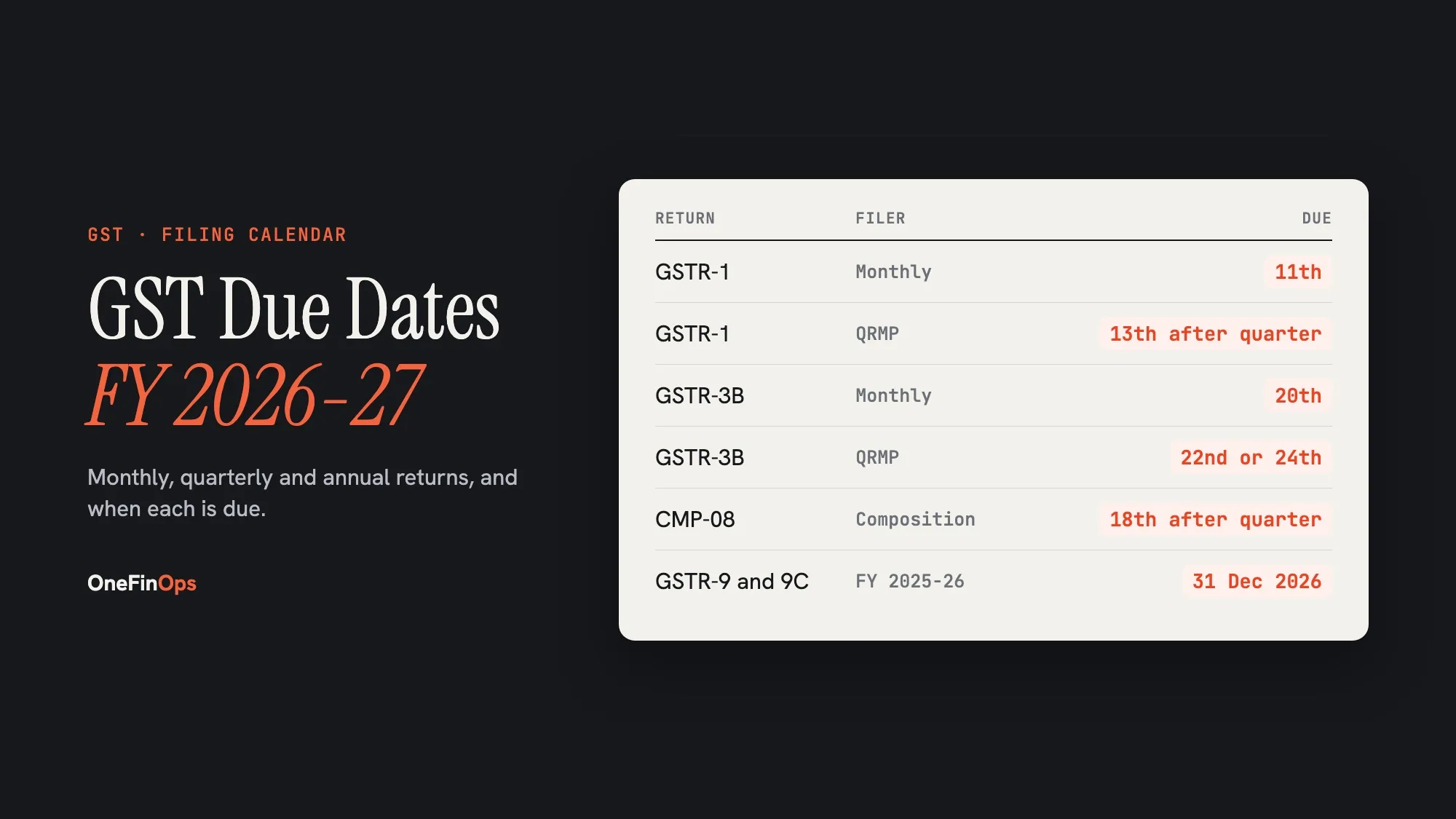
GST due dates for FY 2026-27 are the 11th of the next month for monthly GSTR-1, the 20th for monthly GSTR-3B, the 13th and the 22nd or 24th after each quarter for QRMP filers, and 31 December 2026 for the FY 2025-26 annual return. Miss one and a daily late fee and 18% interest on the cash tax start.
OneFinOps puts every return for each GSTIN on a filing calendar with a named owner, and escalates before the date passes.
Key takeaways
- Monthly filers: GSTR-1 by the 11th, GSTR-3B by the 20th.
- QRMP filers: GSTR-1 by the 13th, GSTR-3B by the 22nd or 24th.
- As of 28 September 2026, no FY 2026-27 GST due date has been extended.
GST due dates for FY 2026-27 at a glance
| Return | Who files | Due date |
|---|---|---|
| GSTR-1 | Monthly filers | 11th of next month |
| GSTR-1 (QRMP) | Turnover up to ₹5 crore, opted in | 13th of month after quarter |
| IFF (optional) | QRMP, months 1 and 2 | 1st to 13th of next month |
| GSTR-3B | Monthly filers | 20th of next month |
| GSTR-3B (QRMP) | QRMP filers | 22nd or 24th of month after quarter |
| PMT-06 | QRMP, months 1 and 2 | 25th of next month |
| CMP-08 | Composition taxpayers | 18th of month after quarter |
| GSTR-4 | Composition taxpayers | 30 June after the year |
| GSTR-7 and GSTR-8 | TDS deductors, e-commerce operators | 10th of next month |
| GSTR-5 and GSTR-6 | Non-residents, input service distributors | 13th of next month |
| GSTR-9 and GSTR-9C | Above ₹2 crore and ₹5 crore turnover | 31 December after the year |
| ITC-04 | Principals sending goods to job workers | 25 October and 25 April (above ₹5 crore), or 25 April |
GSTR-9 is optional up to ₹2 crore under Notification 15/2025-Central Tax. Two dates to diarise now: 30 November 2026, the last date to claim FY 2025-26 ITC under section 16(4), and 31 December 2026 for GSTR-9 and GSTR-9C. Details are in GSTR-9 and GSTR-9C.
Which states file QRMP GSTR-3B on the 22nd and which on the 24th?
22nd: Chhattisgarh, Madhya Pradesh, Gujarat, Maharashtra, Karnataka, Goa, Kerala, Tamil Nadu, Telangana, Andhra Pradesh, Dadra and Nagar Haveli and Daman and Diu, Puducherry, Andaman and Nicobar Islands, Lakshadweep.
24th: Himachal Pradesh, Punjab, Uttarakhand, Haryana, Delhi, Rajasthan, Uttar Pradesh, Bihar, Sikkim, Arunachal Pradesh, Nagaland, Manipur, Mizoram, Tripura, Meghalaya, Assam, West Bengal, Jharkhand, Odisha, Jammu and Kashmir, Ladakh, Chandigarh.
The date follows the state of the registration, so a company registered in Maharashtra and Delhi files on the 22nd and the 24th.
GST late fee and interest
Late fee for GSTR-3B or GSTR-1 is ₹20 a day for a nil return (cap ₹500) and ₹50 a day otherwise, capped at ₹2,000 up to ₹1.5 crore turnover, ₹5,000 up to ₹5 crore and ₹10,000 above. Interest on late tax is 18% a year on the net cash liability.
Example. Sahyadri Foods, ₹8 crore turnover, files its August 2026 GSTR-3B 12 days late with ₹4,50,000 net cash tax. Late fee is 12 × ₹50 = ₹600; interest is ₹4,50,000 × 18% × 12 ÷ 365 = ₹2,663. How the monthly credit match works is in GSTR-2B vs GSTR-3B reconciliation. The GST late fee calculator works out the fee and interest for any return and delay.
How OneFinOps handles GST due dates
The Tax Agent generates due dates per registration and tracks every obligation on the filing calendar, with an owner and a state on each, through to filed. Late and at-risk filings are escalated before the date, and again as it passes. It prepares the return from the period’s postings but does not submit on its own: every filing goes to the named preparer and reviewer first.
The usual setup keeps the calendar in one place and the return in another, and the date lives in somebody’s head. Here the obligation, the return and the evidence are one record.