The month-end close process is the set of accounting tasks a finance team completes after each month ends to record every transaction, reconcile balances, post accruals, review the results and lock the period. Run from a tracker and memory, the first week goes on finding what was missed, and a TDS deposit that slips past the 7th attracts interest.
In OneFinOps, the Close Agent reads each task’s status from the ledger itself.
Key takeaways
- Capture everything, reconcile everything, adjust, then review and lock.
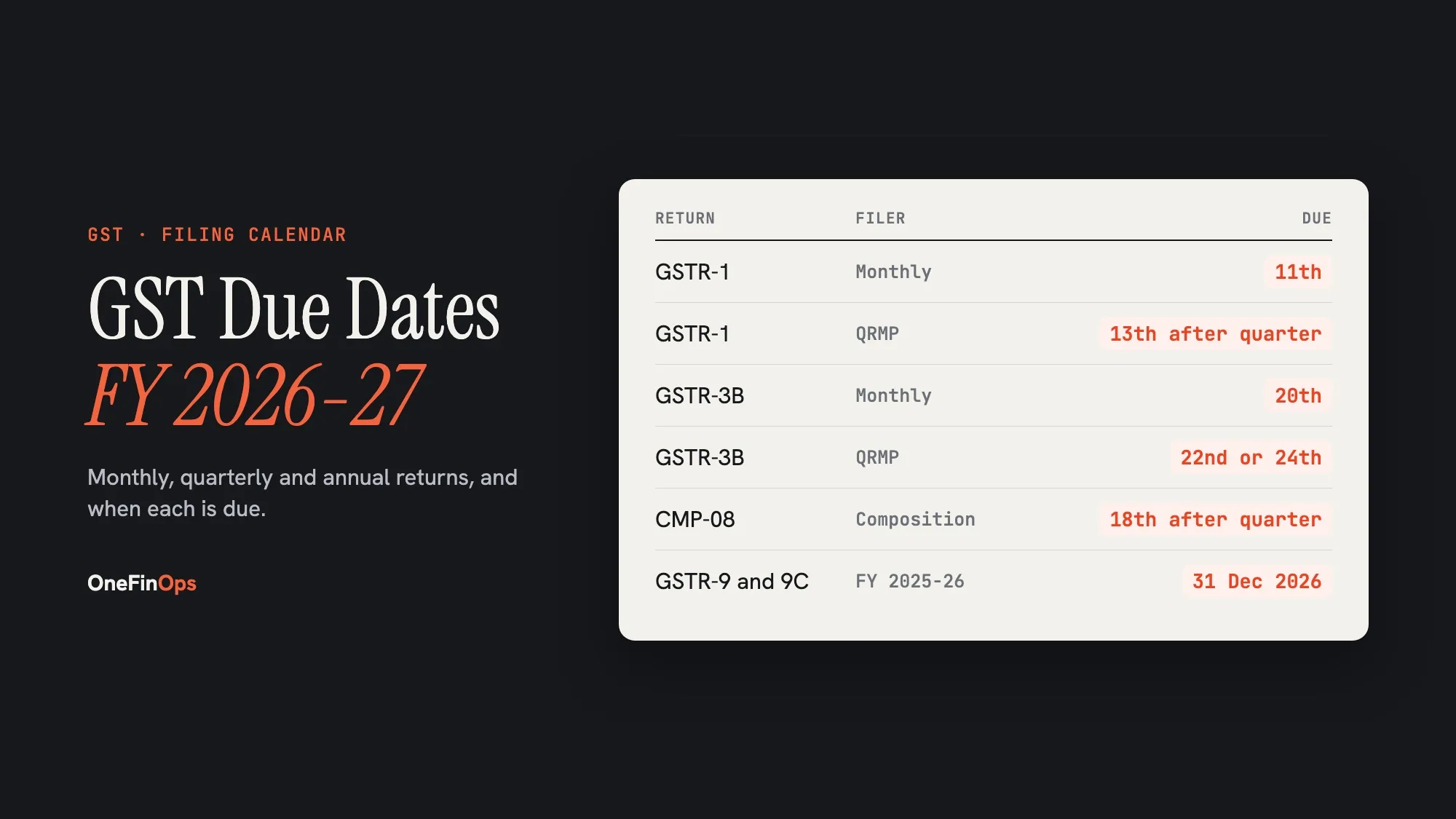
- TDS by the 7th, GSTR-1 by the 11th, GSTR-3B by the 20th.
- The fastest closes reconcile during the month, not after it.
Month-end close process steps
- Cut off and capture every invoice, bill, expense claim and payroll entry dated in the month.
- Reconcile bank and cash with a bank reconciliation statement for every account.
- Reconcile subledgers and tax accounts to control accounts, GSTR-2B and TDS challans.
- Post adjustments: accruals, prepaids, deferred revenue, depreciation, provisions and FX revaluation.
- Reconcile intercompany balances between each pair of entities.
- Review and lock the trial balance, P&L and balance sheet, then publish the MIS pack.
Example: Rao Consulting Pvt Ltd accrues ₹62,000 of September electricity billed in October (Dr Power and Fuel, Cr Accrued Expenses) and amortises ₹30,000 of a ₹3,60,000 annual insurance premium (Dr Insurance, Cr Prepaid Expenses).
Month-end close checklist (India)
For a monthly GST filer closing September 2026:
- Sales invoices, credit notes and vendor bills posted; goods received not invoiced listed
- E-invoices reported to the IRP within 30 days for aggregate turnover of ₹10 crore or more
- Every bank account reconciled; unapplied cash cleared; AR aging provision updated
- GSTR-2B (generated on the 14th) reconciled and IMS actions taken; unmatched credit held back
- TDS and TCS deposited by the 7th (30 April for March); see the TDS due dates guide
- PF and ESI paid by the 15th
- Suspense accounts at zero or explained; manual journals reviewed by someone other than the preparer
Month-end close calendar
Working days (WD) count from the first working day of the next month.
| When | Task | Owner |
|---|---|---|
| WD 1 | Bank reconciliations; payroll posted; sales register closed | Accountant |
| WD 2 | AP and AR subledger reconciliation | AP, AR |
| WD 3 | Accruals, depreciation, provisions, FX revaluation | Accountant |
| WD 3 to 4 | TDS reconciled and paid (deadline: 7th) | Tax |
| WD 5 | Trial balance review, variances, lock | Controller |
| 11th | GSTR-1 filed | Tax |
| 14th to 20th | GSTR-2B reconciliation, IMS actions, GSTR-3B by 20th | Tax |
| 15th | PF and ESI paid | Payroll |
The GST work runs after the lock on purpose: GSTR-3B should come from closed books.
How OneFinOps handles the month-end close
The Close Agent posts accruals, deferrals and reversals on the schedules they were set on, runs revaluation and depreciation for every entity, and reconciles each subledger to its control account, listing the breaks. Tasks show their status from the data, not a tick box.
The judgment stays with people. Every manual journal goes to a reviewer who is not the preparer, and the period lock goes to the group controller, with open exceptions listed.
A close tracker beside the books tracks the work but does not do it. Here payables, receivables, banking and tax post into one ledger as the month runs, so the close is a review.