
TDS (tax deducted at source) is income tax that the payer deducts from a payment, such as salary, contractor fees, rent or interest, and deposits it with the government. From 1 April 2026 it is governed by sections 392 and 393 of the Income Tax Act 2025. Miss a threshold on one bill and the payer owes interest every month.
In OneFinOps, the section, rate and threshold are worked out on each bill before payment, so the deduction is right the first time.
Key takeaways
- TDS is an advance payment of the payee’s tax, not an extra tax.
- Deduct, deposit by the 7th, file quarterly, issue a certificate.
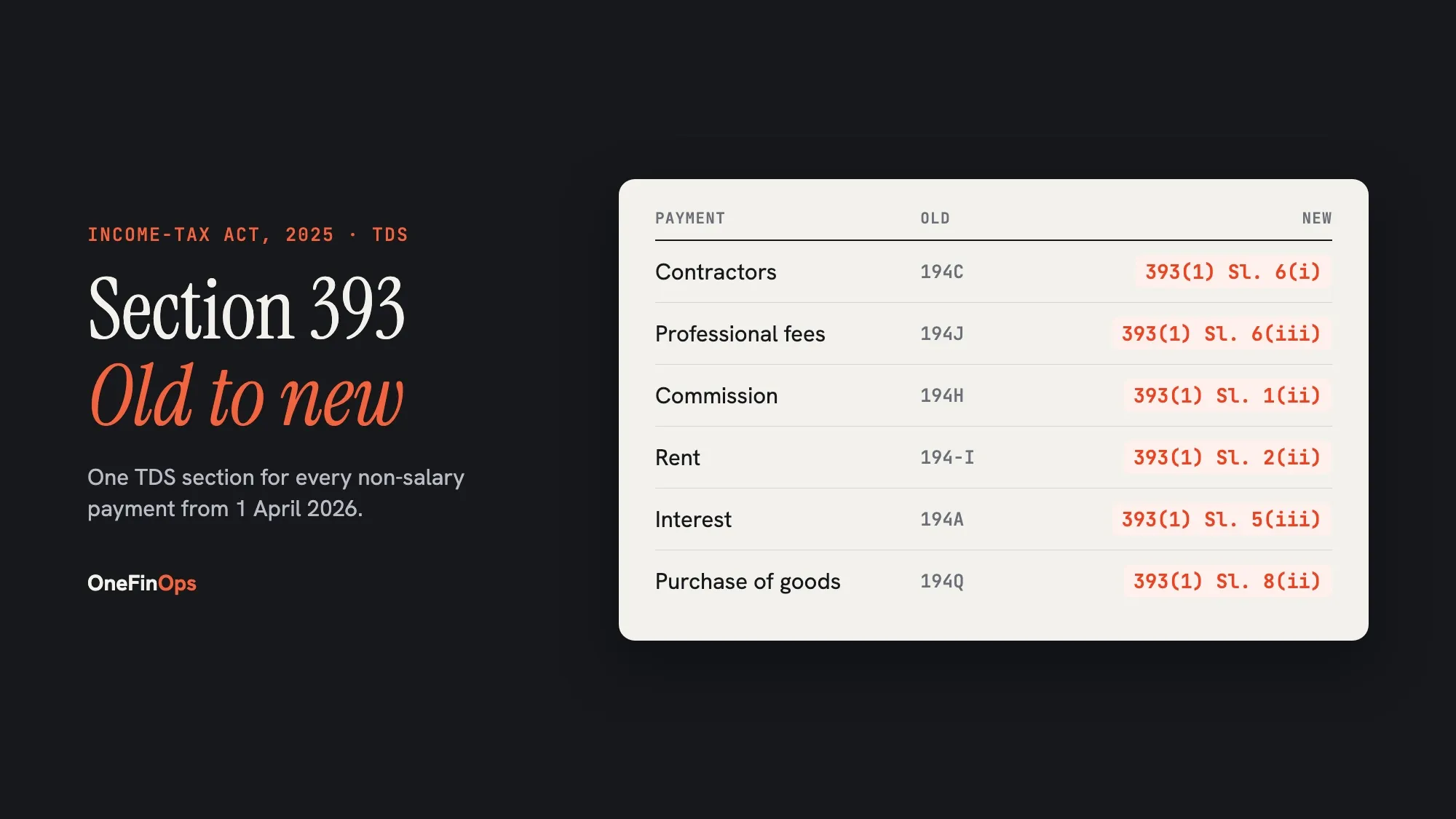
- The 2025 Act kept the rates but renamed sections and forms.
How does TDS work?
A company paying a consultant ₹1,00,000 deducts ₹10,000, pays ₹90,000, and deposits ₹10,000 against the consultant’s PAN.
- Check the row and threshold. For example, no TDS on professional fees until they cross ₹50,000 in the year.
- Deduct at the earlier of crediting the payee in the books or paying.
- Deposit under the payer’s TAN by the 7th of the next month (30 April for March deductions).
- File the quarterly statement: Form 140 for resident non-salary payments, Form 138 for salary, Form 144 for non-residents.
- Issue the certificate: Form 131 (earlier Form 16A) for non-salary TDS, Form 130 (earlier Form 16) for salary.
- The payee claims the credit, shown in Form 168 (earlier Form 26AS), in the income tax return.
TDS rates for FY 2026-27
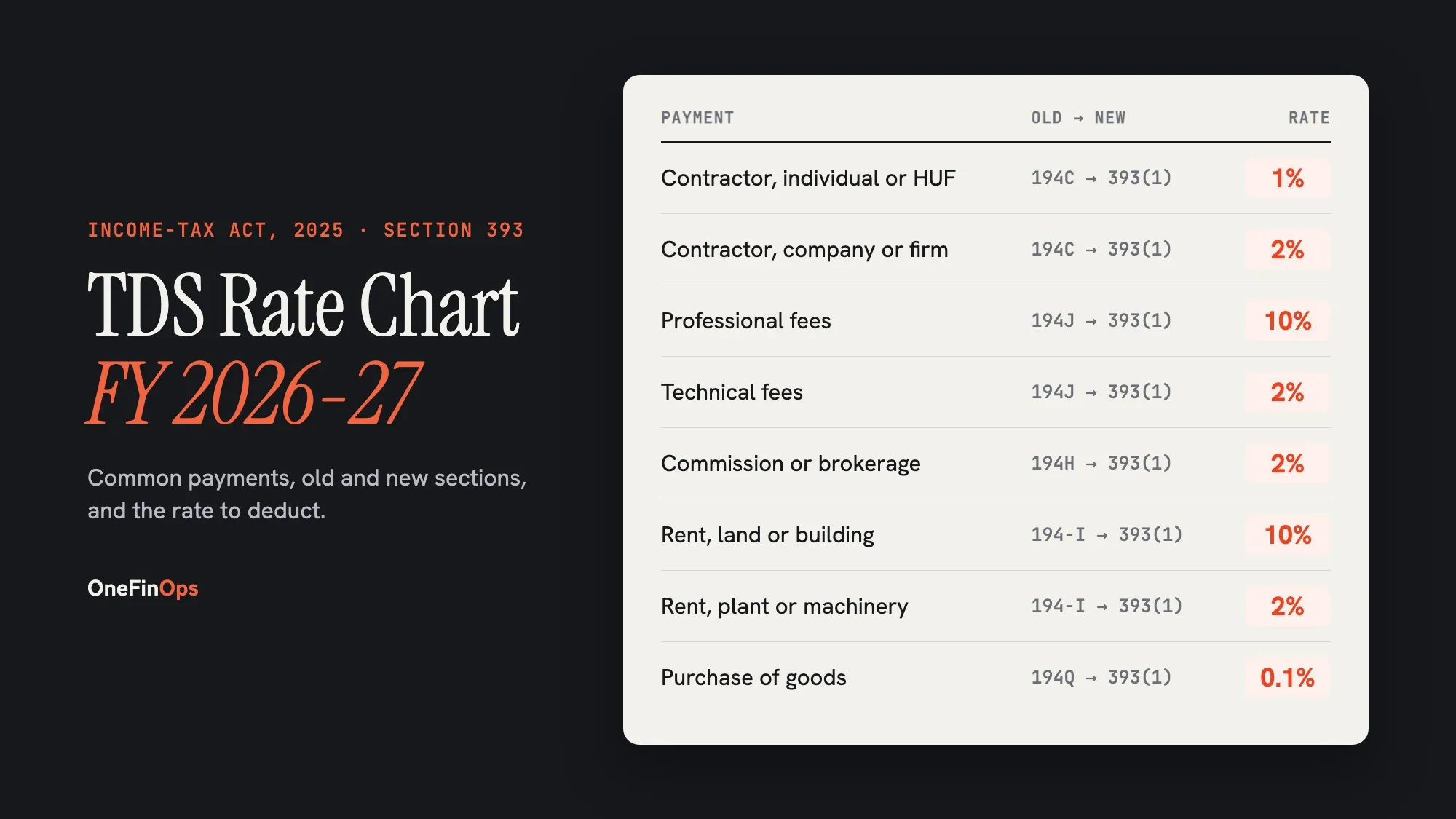
The most common section 393(1) rows for residents:
| Payment | Old section | New section | Threshold | Rate |
|---|---|---|---|---|
| Contractor (individual or HUF) | 194C | 393(1) Sl. 6(i) | ₹30,000 single or ₹1,00,000 in the year | 1% |
| Contractor (others) | 194C | 393(1) Sl. 6(i) | ₹30,000 single or ₹1,00,000 in the year | 2% |
| Professional fees | 194J | 393(1) Sl. 6(iii) | ₹50,000 | 10% |
| Technical services | 194J | 393(1) Sl. 6(iii) | ₹50,000 | 2% |
| Rent of land or building | 194-I | 393(1) Sl. 2(ii) | ₹50,000 a month | 10% |
| Rent of plant or machinery | 194-I | 393(1) Sl. 2(ii) | ₹50,000 a month | 2% |
| Commission or brokerage | 194H | 393(1) Sl. 1(ii) | ₹20,000 | 2% |
| Purchase of goods (buyer turnover above ₹10 crore) | 194Q | 393(1) Sl. 8(ii) | Above ₹50 lakh per seller | 0.1% |
Without a valid PAN, TDS is at least 20% (5% for purchase of goods and e-commerce) under section 397(2). The full list is in our TDS rate chart for FY 2026-27, and the TDS rate chart tool calculates the TDS on any payment.
What happens if you do not deduct or deposit TDS?
Interest under section 398 runs at 1% a month until deducted and 1.5% a month from deduction to deposit. Section 35(b) disallows 30% of the payment until TDS is paid. A late statement costs ₹200 a day under section 427, up to the TDS amount.
How OneFinOps handles TDS
In OneFinOps, the section, rate and threshold are determined by the vendor’s status as the Payables Agent codes each invoice to its tax treatment, with lower deduction certificates applied. The Tax Agent prepares the quarterly return from the postings and reconciles it to the ledger. It never files alone: every return goes to the named preparer and reviewer, and a difference goes to the tax manager with the cause stated.
Unlike a TDS tool fed by exports, the return and the ledger are one record, so the filed figure and the booked figure match.