


Subscription Billing | Billing Automation
The renewal-to-cash loop, with no one in the middle.
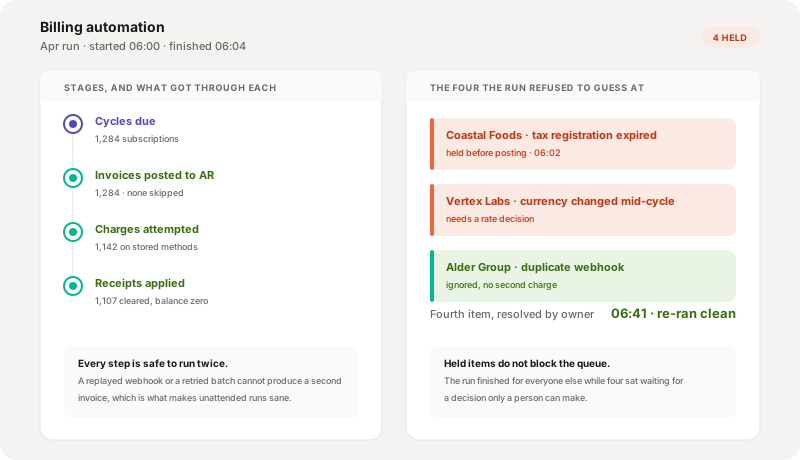
The renewal worker generates the invoice, the invoice posts to receivables, the charge collects, and the cash applies, end to end. Exceptions surface on a queue. The happy path needs no human at all.
What the system does
Capability, input, output.
| Capability | Input | Output |
|---|---|---|
| Renewal worker | Billing cycle due date and subscription state | Invoice generated and linked to the cycle via BillingCycle.invoiceId |
| Invoice posting | Generated invoice from the billing engine | Real AR invoice posted to receivables as the system of record |
| Auto-charge | Stored payment method on the subscription | Charge collected against the invoice on the cycle |
| Cash application | Payment confirmation from the gateway | Receipt applied to the invoice, balance cleared |
| Exception queue | Any step that fails the happy path | Item surfaced for review, rest of the queue unblocked |
| Idempotency | Retry or webhook replay for any step | Safe re-execution with no duplicate invoice or charge |
-
Renewal worker
- Input
- Billing cycle due date and subscription state
- Output
- Invoice generated and linked to the cycle via BillingCycle.invoiceId
-
Invoice posting
- Input
- Generated invoice from the billing engine
- Output
- Real AR invoice posted to receivables as the system of record
-
Auto-charge
- Input
- Stored payment method on the subscription
- Output
- Charge collected against the invoice on the cycle
-
Cash application
- Input
- Payment confirmation from the gateway
- Output
- Receipt applied to the invoice, balance cleared
-
Exception queue
- Input
- Any step that fails the happy path
- Output
- Item surfaced for review, rest of the queue unblocked
-
Idempotency
- Input
- Retry or webhook replay for any step
- Output
- Safe re-execution with no duplicate invoice or charge
Standards + connections
Automation wired to the systems that bill, collect and book.
Billing automation is not a standalone queue. Each step in the loop connects to the module that owns it: receivables owns the invoice, payments own the charge, and the ledger owns the cash. A single renewal drives all three without duplication.
Regulations we work within
-
AR is the system of record
Every invoice generated by the renewal worker posts to receivables as a real AR document. Billing keeps the link, not a second copy of the revenue.
-
Idempotency by design
Every step carries an idempotency key so retries, webhook replays and network failures cannot produce duplicate invoices or duplicate charges.
-
Audit trail
Each transition in the renewal-to-cash loop is logged with timestamp and outcome, so every invoice, charge and receipt is traceable from the originating cycle.
Connects to
- Accounts Receivable Invoice posting and receipt application
- Payments Auto-charge, retries and gateway webhooks
- Accounting Cash posted to the ledger on application
- Exception Queue Failed steps routed for human review
Billing Automation FAQ
What buyers ask.
What triggers the renewal and who schedules it?
The renewal worker runs on a schedule aligned to each billing cycle due date. When a cycle comes due, the worker picks it up, generates the invoice, posts it to receivables and hands off to the payment step. No human action starts the sequence on the happy path.
What happens when a step in the loop fails?
The failing item moves to the exception queue for review. The rest of the renewal queue continues unblocked. Once the issue is resolved, the item re-enters the loop from the failed step, and idempotency keys ensure no duplicate invoice or charge is created on the retry.
How does billing automation handle webhook replays safely?
Every step in the loop carries an idempotency key derived from the subscription, cycle and step. If a webhook fires twice or a retry lands after a success, the engine detects the key and returns the original result without re-executing. Duplicate invoices and duplicate charges cannot occur.
Does the automation work for net-terms invoices as well as auto-charge?
Yes. The renewal worker generates and posts the invoice regardless of collection method. For auto-charge subscriptions the charge step follows immediately. For net-terms subscriptions the invoice is sent to the customer and the cash application step waits for the payment to arrive. Both paths run on the same loop.
More in Subscription Billing
Related features
Recurring Billing
Monthly, quarterly, annual or custom cycles that renew on schedule and generate the next invoice.
See Recurring BillingDunning & Recovery
Smart retries and dunning emails that recover failed payments before they become churn.
See Dunning & RecoveryRecurring Invoicing
Compliant invoices generated on the cycle and posted to receivables as the system of record.
See Recurring Invoicing
See the full loop run on a test subscription.
Trigger a renewal, watch the invoice post to receivables, the charge collect and the cash apply, end to end. Then break a step and see it surface on the exception queue.