


Subscription Billing | Recurring Invoicing
Compliant invoices, generated on the cycle.
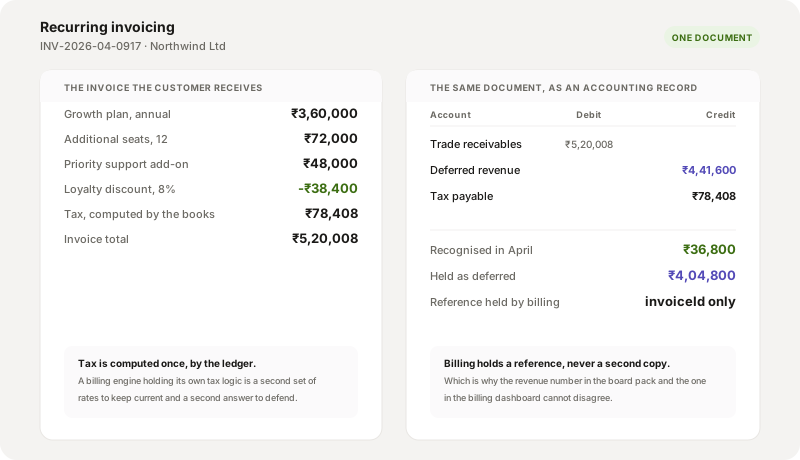
Each billing cycle posts a real invoice to your books, with tax computed by the ledger, not duplicated in billing. Where e-invoicing applies, the IRN and QR are raised on the same invoice. One number, one source of truth.
What the system does
Capability, input, output.
| Capability | Input | Output |
|---|---|---|
| Invoice generation | Billing cycle completion | A real invoice posted to receivables as the system of record |
| Tax computation | Invoice lines, customer tax registration, country rules | Tax computed once by the books, never duplicated in billing |
| E-invoicing | Invoice posted to receivables where the mandate applies | IRN and QR raised on the same document the customer receives |
| Credit notes | Plan change, cancellation or manual adjustment | A credit note against the original invoice, posted to the same ledger |
| Invoice link | Billing cycle record | An invoiceId reference only; billing never holds a second copy of revenue |
| Customer delivery | Invoice finalised | One document that is both the billing record and the accounting entry |
-
Invoice generation
- Input
- Billing cycle completion
- Output
- A real invoice posted to receivables as the system of record
-
Tax computation
- Input
- Invoice lines, customer tax registration, country rules
- Output
- Tax computed once by the books, never duplicated in billing
-
E-invoicing
- Input
- Invoice posted to receivables where the mandate applies
- Output
- IRN and QR raised on the same document the customer receives
-
Credit notes
- Input
- Plan change, cancellation or manual adjustment
- Output
- A credit note against the original invoice, posted to the same ledger
-
Invoice link
- Input
- Billing cycle record
- Output
- An invoiceId reference only; billing never holds a second copy of revenue
-
Customer delivery
- Input
- Invoice finalised
- Output
- One document that is both the billing record and the accounting entry
Standards + connections
Invoices that satisfy both billing and the books.
Because billing and receivables share one engine, an invoice generated on the cycle is already a proper accounting document. Tax rules, e-invoicing mandates and recognition schedules apply to the same record, so nothing needs to be reconciled after the fact.
Regulations we work within
-
AR is the system of record
Billing posts each cycle invoice to receivables and retains only the invoiceId link. Revenue lives in one place.
-
Country tax compliance
Tax is computed by the accounting layer per country rule. Where an e-invoicing mandate applies, IRN and QR are raised on the same invoice that went to the customer.
-
IFRS 15 and Ind-AS 115
Recognition schedules are derived from the subscription term, so deferred and recognised revenue post on the correct period.
Connects to
- Accounts Receivable Invoice SoR, credit notes and receipts
- Tax Computed once, applied to the posted invoice
- Accounting Deferred and recognised revenue posting
- Payments Collected against the same invoice record
Recurring Invoicing FAQ
What buyers ask.
Why does it matter that billing posts a real invoice to receivables?
When billing and receivables are separate systems, revenue lives in two places and has to be reconciled. Here, the billing cycle triggers one invoice that is also the accounting record. Tax is computed by the books, recognition schedules derive from the term, and the cash collected applies against that same document. There is no sync to run and no second source of truth.
How does e-invoicing work for customers in a mandate country?
The invoice is posted to receivables first, which is where tax and e-invoicing are handled. Where the mandate applies, the IRN and QR code are fetched and attached to that invoice before it reaches the customer. Billing is country-agnostic; the tax layer applies the local rules. The customer receives one document that satisfies both the billing record and the compliance requirement.
What generates a credit note, and how does it relate to the original invoice?
Credit notes are raised in receivables against the original invoice, whether the trigger is a plan change, a cancellation, or a manual adjustment. Because billing and AR are one engine, the credit posts on the correct period and the customer sees one corrected document rather than a separate adjustment from a separate system.
Can the same setup handle customers in multiple countries with different tax rules?
Yes. The billing engine is country-agnostic. Each invoice posts to receivables, which applies the tax rules for that customer based on registration, country and transaction type. You configure plans and prices once; the tax layer handles the jurisdiction. Where an e-invoicing mandate applies in a specific country, that logic is isolated to the tax layer and does not affect the billing configuration.
More in Subscription Billing
Related features
Recurring Billing
Monthly, quarterly, annual or custom cycles that renew on schedule and generate the next invoice.
See Recurring BillingRevenue Recognition
Deferred revenue and recognition schedules derived from the subscription term, not maintained by hand.
See Revenue RecognitionBilling Automation
The renewal-to-cash loop running end to end, with exceptions surfaced on a queue and no one in the middle.
See Billing Automation
See a billing cycle post a compliant invoice to the books.
Set up a test subscription, run a cycle, and watch the invoice post to receivables, tax compute once, and the accounting entry land on the right period.