


Subscription Billing | Recurring Billing
Renewals that run themselves.
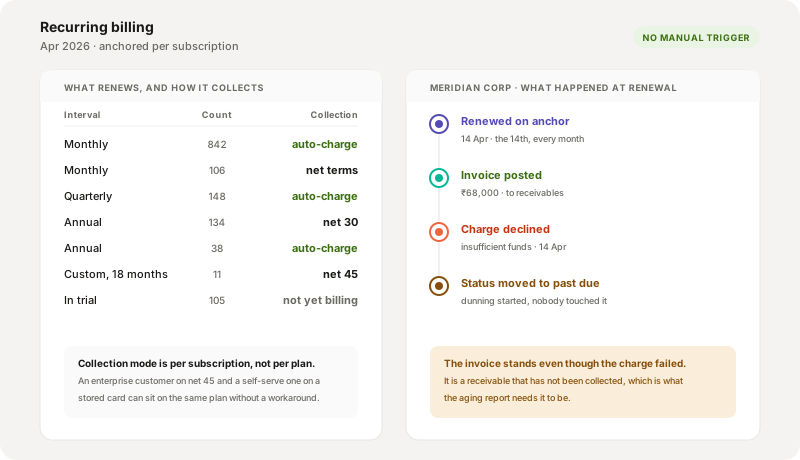
Monthly, quarterly, annual or custom cycles renew on schedule and generate the next invoice with no manual step. Set collection mode per subscription: auto-charge a stored payment method or issue a net-terms invoice. The cycle is the contract.
What the system does
Capability, input, output.
| Capability | Input | Output |
|---|---|---|
| Billing cycles | Monthly, quarterly, annual or custom interval | Next invoice generated on schedule, no manual trigger |
| Collection mode | Auto-charge or net-terms, set per subscription | Stored payment method charged, or invoice sent for payment |
| Invoice posting | Cycle renewal event | Real invoice posted to receivables as the system of record |
| Failed charge handoff | Declined or failed payment | Subscription moves past-due and dunning sequence begins |
| Cycle anchor | Subscription start date or explicit anchor | All future cycles aligned, proration handled on the first period |
| Subscription statuses | Trial, active, past-due, paused, cancelled, expired | Single status the billing engine and your team share |
-
Billing cycles
- Input
- Monthly, quarterly, annual or custom interval
- Output
- Next invoice generated on schedule, no manual trigger
-
Collection mode
- Input
- Auto-charge or net-terms, set per subscription
- Output
- Stored payment method charged, or invoice sent for payment
-
Invoice posting
- Input
- Cycle renewal event
- Output
- Real invoice posted to receivables as the system of record
-
Failed charge handoff
- Input
- Declined or failed payment
- Output
- Subscription moves past-due and dunning sequence begins
-
Cycle anchor
- Input
- Subscription start date or explicit anchor
- Output
- All future cycles aligned, proration handled on the first period
-
Subscription statuses
- Input
- Trial, active, past-due, paused, cancelled, expired
- Output
- Single status the billing engine and your team share
Standards + connections
Recurring billing wired to receivables, payments and tax.
A billing cycle is not an isolated event. Each renewal posts a real invoice to receivables, collection routes through the payments layer, and tax is computed once by the books. Local compliance rules apply at the invoice level, not in the billing engine.
Regulations we work within
-
AR is the system of record
Billing orchestrates the cycle and posts to receivables. The invoice lives in AR, so revenue is never duplicated across two systems.
-
Country-agnostic billing
The billing engine carries no country-specific logic. Tax, e-invoicing and local compliance run at the invoice layer, per country, on the same document.
-
Audit trail
Every cycle event, charge attempt and status change is logged with time and reason, covering the full renewal-to-cash path.
Connects to
- Accounts Receivable Invoice posted each cycle as the source of truth
- Payments Auto-charge stored methods or route to net-terms
- Dunning Failed charges hand off automatically
- Tax Computed by the ledger, per country, on the invoice
Recurring Billing FAQ
What buyers ask.
What billing cycle frequencies are supported?
Monthly, quarterly, semi-annual and annual are built in. Custom intervals are also supported, so if your contracts bill every 4 weeks, every 6 months on a specific date, or on any other cadence, you can configure the cycle to match. The anchor date keeps all future renewals aligned.
Can different subscriptions use different collection modes?
Yes. Collection mode is set per subscription, not globally. One customer can be on auto-charge with a stored card while another receives a net-terms invoice each cycle. The billing engine handles both paths and posts the same invoice to receivables either way.
What happens if a payment fails on renewal?
The subscription moves into a past-due state and the dunning sequence begins. The engine retries on the schedule you configure, sends dunning emails, and can surface a hosted page for the customer to update their card. Recovered payments close the past-due status and resume the normal cycle.
How does recurring billing stay compliant across countries?
The billing engine is country-agnostic. It generates the invoice and posts it to receivables. Tax computation, e-invoicing and any local compliance rules run at the invoice layer, on that same document, per the rules for the customer country. Billing does not need to change when you expand to a new market.
More in Subscription Billing
Related features
Subscription Management
Trials, upgrades, downgrades, pauses, add-ons and cancellations on one timeline, with entitlements that update the moment a plan changes.
See Subscription ManagementRecurring Invoicing
Each billing cycle posts a real invoice to receivables, with tax computed by the ledger and e-invoicing raised on the same document.
See Recurring InvoicingDunning & Recovery
Smart retries, dunning emails and a hosted update-card page recover failed charges before they churn.
See Dunning & Recovery
See a billing cycle run from renewal to invoice to cash.
Set up a test subscription, let a cycle renew, and watch the invoice post to receivables, the charge collect, and the cash apply, end to end, with no one in the middle.