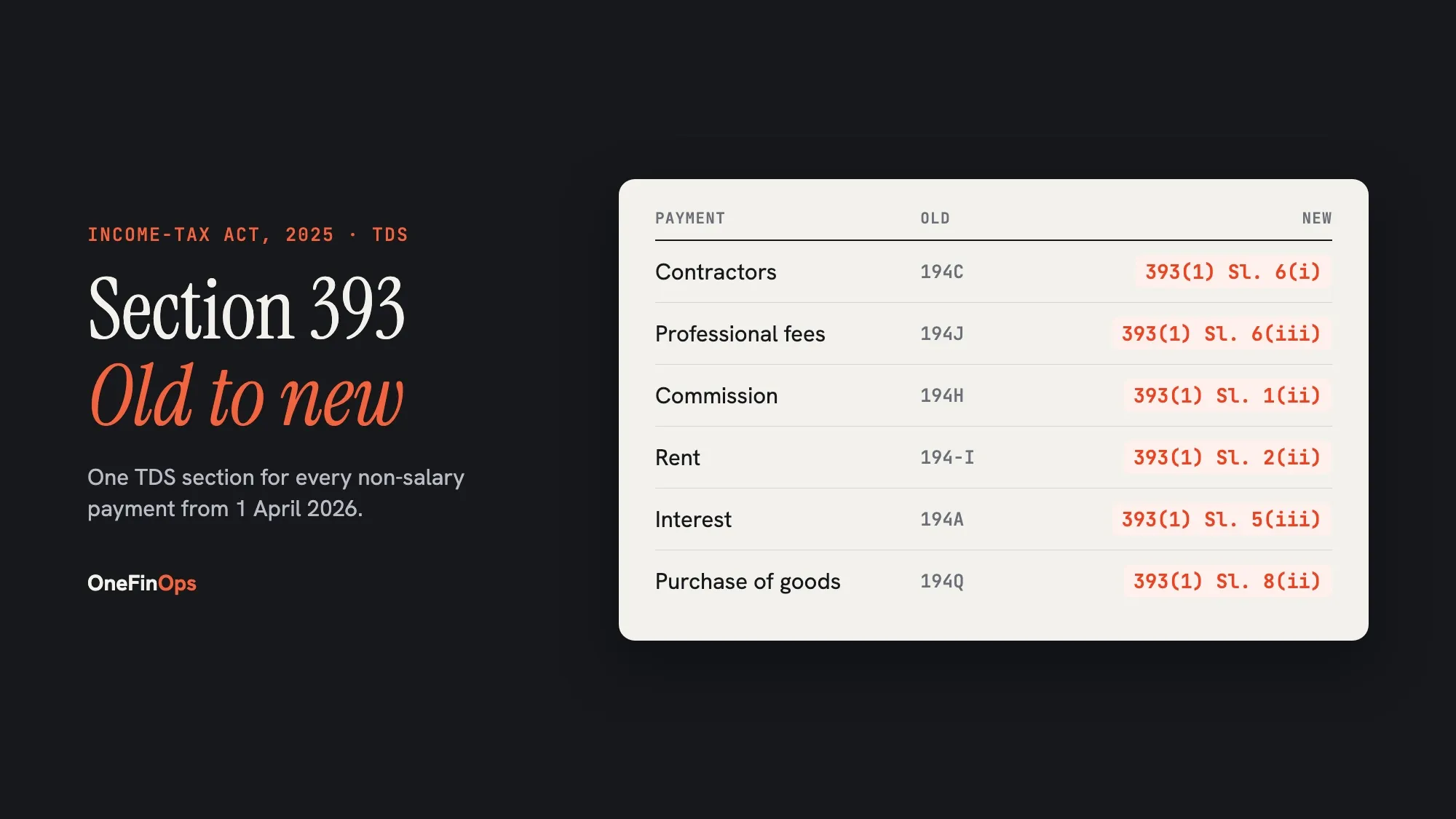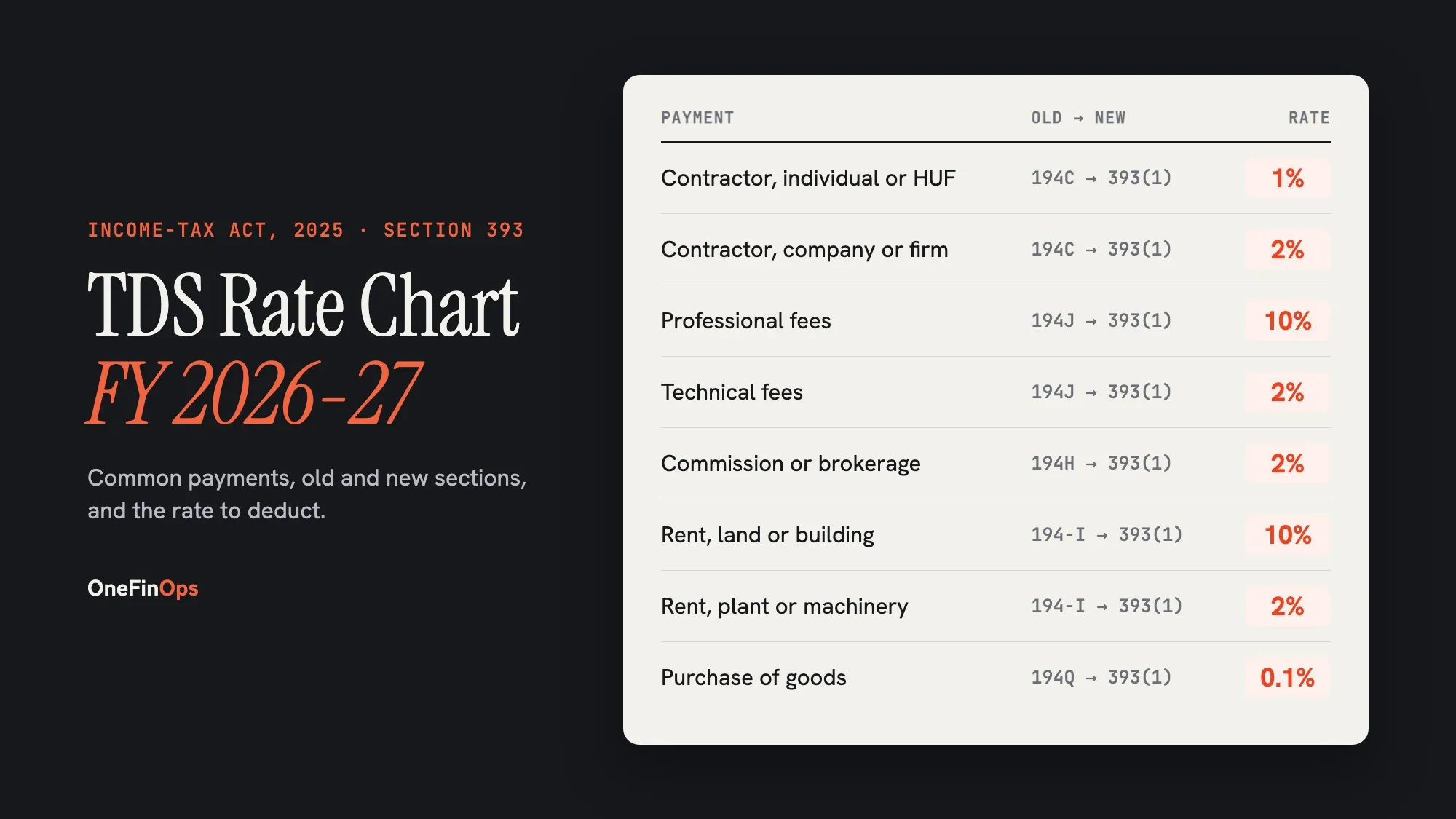

Section 194Q is the TDS a large buyer deducts on goods bought from a resident seller, now section 393(1), Table Sl. No. 8(ii) of the Income Tax Act 2025, payment code 1031. A buyer with turnover above ₹10 crore deducts 0.1% on purchases above ₹50 lakh from one seller. Miss the crossing invoice and every later bill is short-deducted.
In OneFinOps, the threshold is determined per vendor as each bill is coded, so the crossing invoice is caught when it arrives.
Key takeaways
- 0.1% on the amount above ₹50 lakh per seller per year.
- Report under payment code 1031 in Form 140.
- TCS under 206C(1H) stopped from 1 April 2025, with no successor.
What is the new section for 194Q?
| 1961 Act | Income Tax Act 2025 | |
|---|---|---|
| Section | 194Q | 393(1), Table Sl. No. 8(ii) |
| Who deducts | Buyer with turnover above ₹10 crore in the preceding financial year | Buyer, defined in section 402 as turnover above ₹10 crore in the preceding tax year |
| Rate | 0.1% | 0.1% |
| No-PAN rate | 5% (section 206AA) | 5% (section 397(2)) |
| Payment code | Section code 94Q | 1031 |
| Quarterly statement | Form 26Q | Form 140 |
| Certificate to seller | Form 16A | Form 131 |
The substance carried over. Any credit or payment on or after 1 April 2026 is reported under code 1031, not “194Q”.
Who has to deduct TDS under section 194Q?
You deduct if all of these are true:
- Your business turnover exceeded ₹10 crore in the preceding tax year (2025-26 for tax year 2026-27).
- You are buying goods, not services. Capital goods are not excluded.
- The seller is a resident.
- Your purchases from that seller cross ₹50 lakh in the tax year. The count resets on 1 April.
- No other TDS or TCS provision applies to the transaction.
How does the 194Q threshold and GST work?
TDS is 0.1% of the amount above ₹50 lakh, at credit or payment, whichever is earlier. Under CBDT Circular 13/2021, deduct on the value excluding GST when it is shown separately, and on the full amount for advances.
Example: Rao Pharma Distributors (₹84 crore turnover in 2025-26) buys ₹53,00,000 of packaging from one seller by August. The August invoice carries ₹3,00,000 above the threshold, so TDS is ₹300. Every later invoice is taxed in full: ₹16,00,000 in October means ₹1,600.
How OneFinOps handles 194Q
The Payables Agent reads each supplier bill, matches it to the order and receipt, and codes it to its tax treatment from the vendor’s status, so the invoice that crosses ₹50 lakh is deducted from the right rupee. The Tax Agent builds the quarterly statement from the same postings. Nothing is filed until the named preparer and reviewer have seen it.
In most setups someone rebuilds the running total at quarter end. Here the bill, the deduction and the return are one record.