Expense management is the process a business uses to capture, check, approve, reimburse and account for money employees spend on its behalf, such as travel, meals and fuel. Run by email and paper, it leaks quietly: a hotel bill claimed twice, a flight invoice without the company GSTIN so the credit is lost, an advance left open until the audit.
In OneFinOps, the Expenses Agent reads each receipt, applies your policy and posts the claim, so managers only see rule breaks.
Key takeaways
- It covers employee spend that does not go through a purchase order.
- Limits, bill checks and duplicate detection stop most leakage.
- A GST invoice with the company GSTIN protects input tax credit.
What is the expense management process?
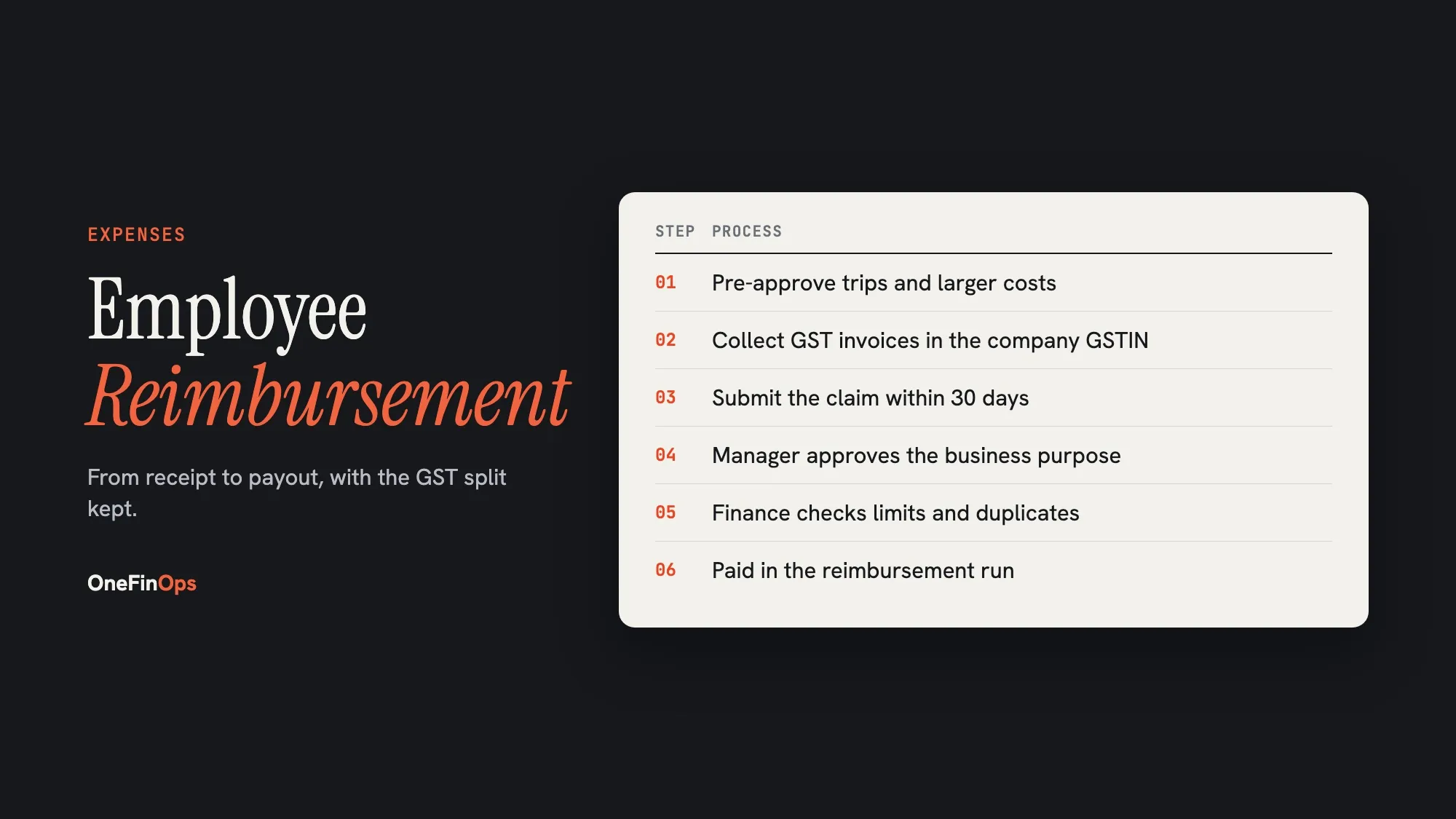
- Set the policy. Finance writes the expense policy: what can be claimed, limits by grade and city, bills required and deadlines. See our expense policy template.
- Pre-approve outstation travel, client entertainment and high-value buys. An advance may be issued.
- Spend and capture. The employee pays and captures the bill at the time, with the business purpose.
- Submit and approve. Bills are grouped into a claim within the deadline, and the reporting manager confirms business need.
- Audit. Finance checks the bill, the limits, duplicates and GST details.
- Pay and post. Claims are paid in a regular run and posted with cost centre and GST split. Advances are settled. See employee reimbursement.
What are the types of business expenses?
| Category | Typical examples | Usual control | GST credit (general position) |
|---|---|---|---|
| Travel | Air, train, cab to airport | Class of travel by grade, pre-approval | Often available on air tickets booked with company GSTIN |
| Accommodation | Hotel stays on tour | Nightly cap by city tier | Depends on tariff and state registration |
| Local conveyance | Auto, cab, own vehicle | Per-km rate, monthly cap | Rent-a-cab credit generally blocked unless an exception applies |
| Meals and per diem | Meals on tour, daily allowance | Per diem by city tier | Food and beverages are blocked under section 17(5) of the CGST Act |
| Small purchases | Stationery, courier | Per-item cap, else raise a PO | Available with a valid tax invoice |
This is a starting point, not tax advice. See input tax credit for the conditions.
Expense management example
Priya, a sales manager in Bengaluru, visits clients in Pune for two nights with a ₹10,000 advance. Her flight, hotel, cabs, per diem and a pre-approved client dinner total ₹29,820. The airline invoice carries the company GSTIN, so ₹450 is booked as input IGST and ₹29,370 as expense. The claim less the advance leaves ₹19,820 payable in the next run.
How OneFinOps handles expense claims
The Expenses Agent reads merchant, amount, date and tax off each receipt and builds the claim. It applies the rule for the employee’s grade, category and location, approves claims inside policy, and posts them with the recoverable tax split out. A claim that breaks a rule goes to the manager with the rule quoted, and the reimbursement run is released by the person who holds the mandate.
Most setups collect bills in one tool and rekey them into a separate ledger, so the GST split is fixed by hand at month end. Here the claim, the payment run and the ledger are one record.
See how the Expenses Agent works