Employee reimbursement is the repayment by a company of business expenses an employee paid from personal funds, such as travel, hotels, fuel or client meals. When it runs on email, claims wait weeks, the same bill gets paid twice, and GST on invoices without the company GSTIN is simply lost.
In OneFinOps, the Expenses Agent builds each claim from the receipt and posts it with the tax split, so employees are paid on a known date.
Key takeaways
- A reimbursement repays actual spend against bills; an allowance is fixed.
- Reimbursed business spend is generally not the employee’s income.
- On approval, book expense and a liability; on payment, clear it.
What is the employee reimbursement process?
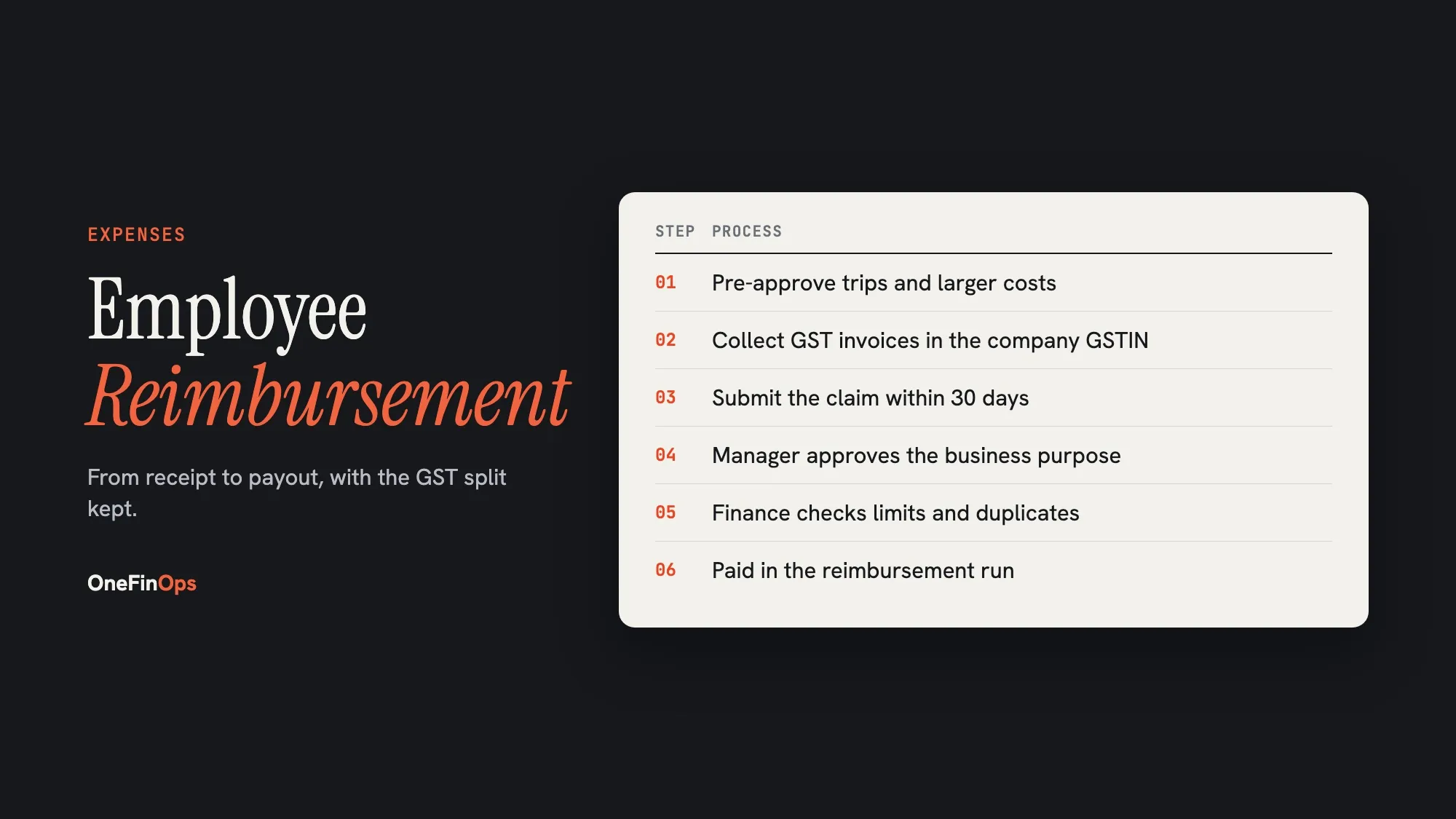
- Pre-approval for outstation trips and larger costs. A travel advance may be paid.
- Spend and collect bills. Hotels, flights and purchases need a GST tax invoice with the company GSTIN.
- Submit the claim with date, category, amount, business purpose and bills, usually within 30 days.
- Manager approval confirms the spend was for business.
- Finance verification checks amounts, policy limits, duplicates, GST details and open advances.
- Payment and accounting in a reimbursement run, booked to the right ledger and cost centre.
The rules behind each step belong in your expense policy.
Is employee reimbursement taxable under the Income-tax Act, 2025?
From 1 April 2026, the Income-tax Act, 2025 replaced the 1961 Act. Business expenses reimbursed against bills are the employer’s cost, not the employee’s income. Paying an employee’s personal phone bill or gym membership is generally a perquisite (section 17, earlier section 17(2)). A fixed allowance is taxable as salary unless specifically exempt under section 11 read with Schedule III (earlier section 10(14)), so keep it in payroll.
Employee reimbursement journal entry with example
Kavya took an ₹8,000 advance and claims ₹11,380 for a Chennai trip: a flight of ₹5,250 including IGST ₹250 on a company GSTIN invoice, cabs of ₹1,630, and a client lunch of ₹4,500 including GST ₹214 (food, so blocked).
| Account | Debit (₹) | Credit (₹) |
|---|---|---|
| Travelling expenses (5,000 + 1,630) | 6,630 | |
| Business promotion (client lunch) | 4,500 | |
| Input IGST | 250 | |
| To Employee advance: Kavya | 8,000 | |
| To Employee reimbursement payable: Kavya | 3,380 |
When the balance is paid: debit Employee reimbursement payable ₹3,380, credit Bank ₹3,380.
How OneFinOps handles reimbursements
The Expenses Agent reads merchant, amount, date and tax off each receipt and codes the claim to project and cost centre. It tests the amount against the grade limit and category rule, approves what is inside policy and posts it with the recoverable tax separated. A claim that breaks a rule goes to the manager with the rule quoted, and the reimbursement run is released by the person who holds the mandate.
The usual setup collects claims in one tool and pays them from another. Here, approved claims join the same payment run as vendor payments and post to the ledger in the same step.
See how reimbursement works in OneFinOps