An expense policy for employees is the written rule book that says which business costs staff may claim, how much they can spend by grade and city, which bills they must submit and who approves. Without one, every claim becomes a negotiation, and a hotel booked without the company GSTIN loses its input tax credit.
A policy only helps if it is checked on every claim. In OneFinOps, the Expenses Agent applies it when the receipt comes in.
Key takeaways
- Keep it short, with the limits in an annexure updated each April.
- Set limits by grade and city tier; per diem for meals.
- Require GST invoices with the company GSTIN for hotels and flights.
Expense policy template for Indian companies
Copy the text below and replace the items in square brackets. The limits are examples for a mid-sized company as of September 2026.
1. Scope. This policy covers business expenses incurred by employees of [Company Name] in India. Vendor purchases above [₹25,000] go through procurement with a purchase order.
2. Principle. An expense is reimbursable only if it is incurred wholly for the Company’s business, is within the limits in Annexure A, and has the documents in clause 5.
3. Travel and hotels. Outstation travel is approved in advance by the reporting manager. Book in the Company name, with the Company GSTIN for the state where the service is provided. Hotels are paid up to the nightly cap in Annexure A, inclusive of taxes, and meals through a per diem with no bills required.
4. Local conveyance. Cabs and autos at actuals up to [₹3,000] per month with receipts. A personal vehicle at [₹12] per km for a car and [₹5] per km for a two-wheeler, with a trip log.
5. Receipts and GST. A bill is required for every expense above [₹500], except the per diem. Hotels, flights and purchases need a GST tax invoice with the Company’s name and GSTIN. Without the Company GSTIN, Finance may reimburse the amount net of GST.
6. Advances. Travel advances up to [70%] of the estimated cost are settled within [15] days of return.
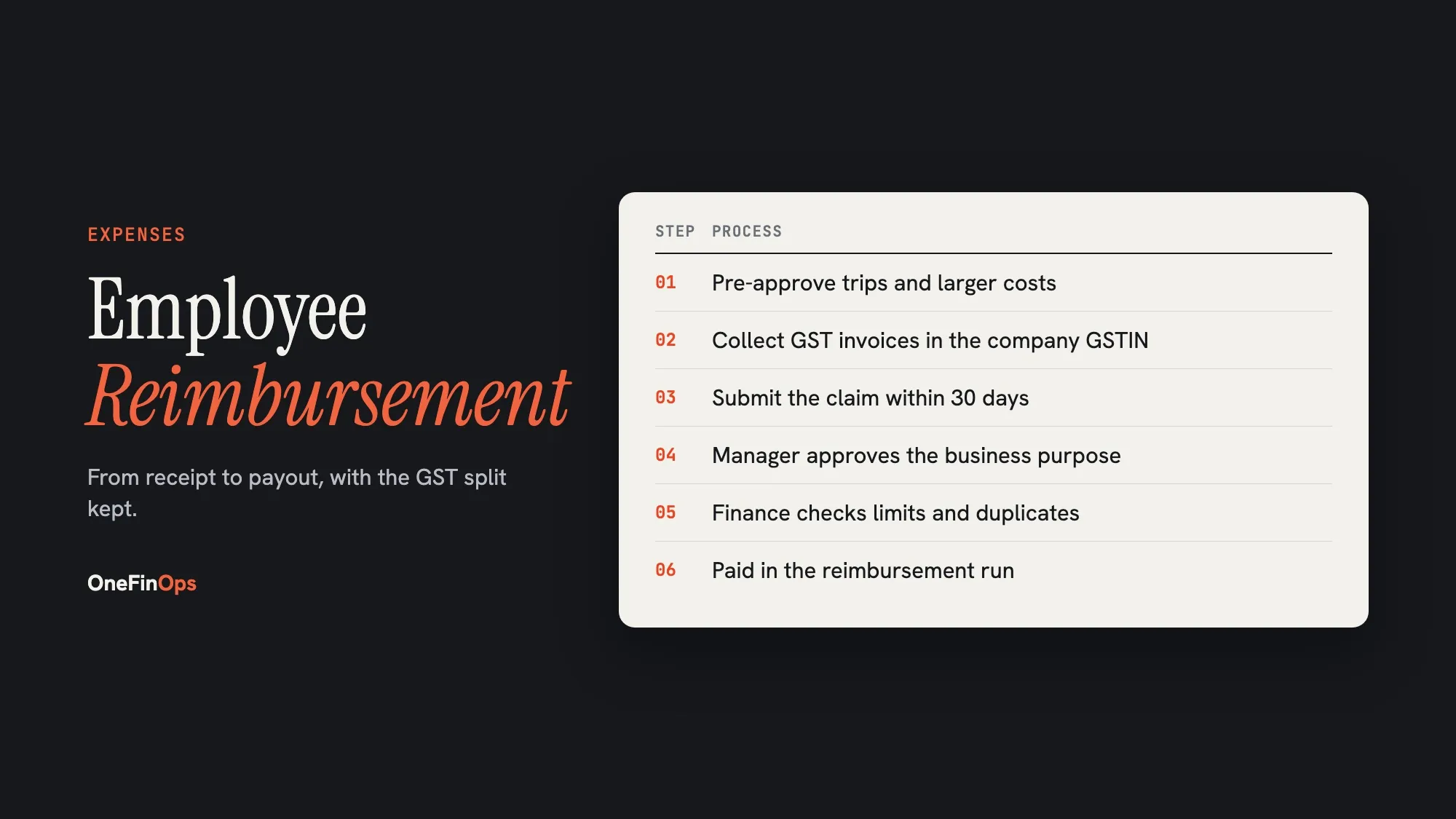
7. Claims and approvals. Submit claims within [30] days of the expense. Claims up to ₹25,000 need the reporting manager; above that, the department head too, and above ₹1,00,000 the CFO. No employee approves their own claim.
8. Not reimbursed. Personal travel, fines, alcohol outside approved client events, family costs, and anything without the required documents.
9. Violations. Out-of-policy amounts are not paid or are recovered. False, altered or duplicate bills are misconduct under the disciplinary policy.
10. Ownership. Owned by the [CFO]. Annexure A is reviewed every April. Effective date: [1 October 2026].
Annexure A: expense limits (example)
Tier 1 is Mumbai, Delhi NCR, Bengaluru, Chennai, Hyderabad, Kolkata, Pune and Ahmedabad. Tier 2 is other state capitals and large cities. Tier 3 is everywhere else.
| Grade | Air | Train | Hotel per night (Tier 1 / 2 / 3) | Per diem per day (Tier 1 / 2 / 3) |
|---|---|---|---|---|
| L1: Executives | Economy, if over 500 km | 3AC | ₹4,500 / ₹3,500 / ₹2,500 | ₹900 / ₹700 / ₹500 |
| L2: Managers | Economy | 2AC | ₹6,500 / ₹5,000 / ₹3,500 | ₹1,200 / ₹1,000 / ₹700 |
| L3: Senior managers | Economy; premium economy over 4 hours | 1AC | ₹9,000 / ₹7,000 / ₹5,000 | ₹1,800 / ₹1,400 / ₹1,000 |
| L4: CXOs, directors | Business | 1AC | Actuals, reasonable | ₹2,500 / ₹2,000 / ₹1,500 |
Example: Arjun (L2) stays two nights in Mumbai at ₹7,800 a night. His cap is ₹6,500. Without a pre-approved exception, the Company pays ₹13,000 and ₹2,600 is his cost.
How OneFinOps puts the policy to work
Your Annexure A becomes rules by category, grade and location, and the employee sees the limit before spending. The Expenses Agent reads each receipt, applies the rule, approves claims inside policy and posts them with the recoverable tax split out. What breaks a rule goes to the manager with the rule quoted.
In most setups the policy lives in a PDF, and the rule is discovered when finance rejects the claim weeks later. Here the rule is checked at capture, and rule changes carry effective dates.
See how the Expenses Agent works